About Carex bullata Willd.
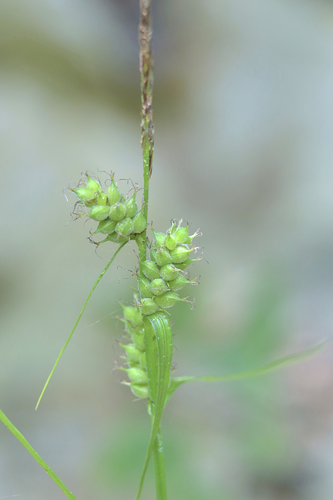
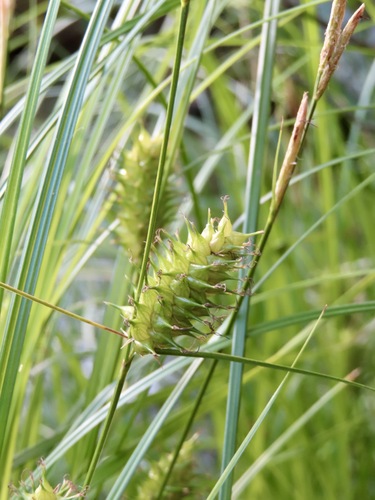
Carex bullata Willd. has stem leaf blades that measure between 1.8 and 5 millimeters wide. Its lowest bract does not have a sheath, its lowest spike has a peduncle, and its highest spike bears only staminate flowers. The perigynium is hairless and ranges from 5.9 to 10.2 millimeters in length. The leaf sheath is smooth and hairless, with a pink, red, or purple tint. Globally, Carex bullata has a conservation rank of G5, meaning it is a secure species; this global ranking was last reviewed in 1997. It also holds multiple local conservation ranks across Canada and the United States: it is ranked S5 (secure) in New Jersey, S4 in Nova Scotia and Virginia, S3 in Delaware, Maryland, and Tennessee, S2 in Maine and North Carolina, and S1 in Arkansas, Mississippi, New Hampshire, New York, and Pennsylvania. Within New England, it occurs in all counties of Rhode Island; all counties of Massachusetts except Berkshire County; all counties of Connecticut except Fairfield and Hartford Counties; Hillsborough and Strafford Counties in New Hampshire; and York, Cumberland, Oxford, and Penobscot Counties in Maine. In Tennessee, it is found in Johnson, Cannon, Coffee, Grundy, Franklin, Moore, and Lincoln Counties. In New York, it occurs in Nassau, Orange, Queens, Richmond, Rockland, and Suffolk Counties. This species grows in stream margins alongside red maple and in sedge marshes. A common habitat for it is also wet pine barrens along railroad tracks. It can additionally be found in wet, muddy stream banks within sedge meadows. It associates with the following other Carex species: Carex barrattii, Carex comosa, Carex scoparia, Carex silicea, Carex stricta, and Carex vestita. It is most commonly found at elevations between 0 and 1,000 feet.