About Carex brevior (Dewey) Mack. ex Lunell
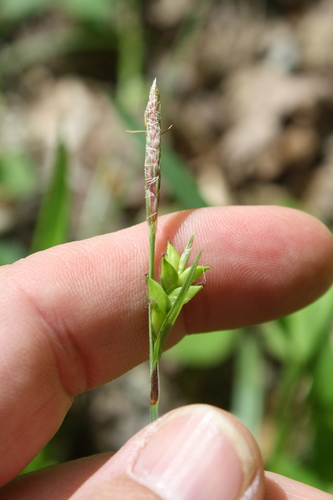
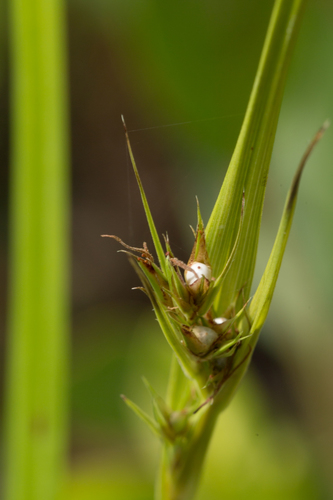
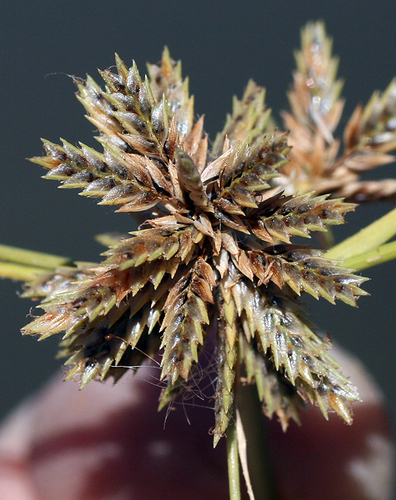
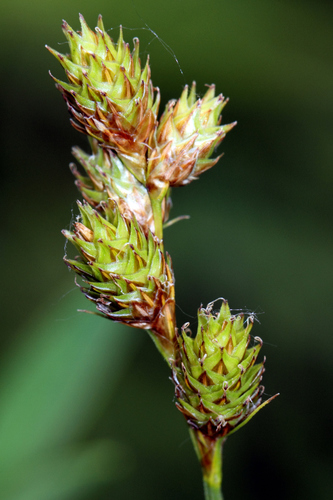
Carex brevior (Dewey) Mack. ex Lunell forms dense tufts with short-prolonged rhizomes, and its clumps sometimes appear elongated. Flowering culms of this species are 15–120 cm (5.9–47.2 in) tall, with 3 to 5 leaves growing on each culm. It produces few vegetative culms, and unlike many other sedges, its leaves are not arranged in a striking 3-ranked pattern. Its leaf sheaths are white and papery, and the ligule measures 2.2–3.3 mm (0.087–0.13 in) long. The inflorescence is open, brown, and grows up to 6.5 cm (2.6 in) long, with 3 to 7 separate, distinct spikes on each culm. Each spike is ovoid or ellipsoid, typically tapering at the base and ending in an acute or rounded tip, and bears 15–40 lens-shaped perigynia. The perigynia range in color from green to reddish brown, and have a shape from orbiculate to broadly ovate. They typically measure 3.4–4.8 mm (0.13–0.19 in) long and 2.3–3.2 mm (0.091–0.126 in) across, and are 1.2–1.8 times as long as they are wide. Carex brevior flowers during mid-May and early June, and produces fruit from early to mid summer. As a member of Carex sect. Ovales, it is commonly confused with other closely related species: Carex molesta, C. molestiformis, and C. cumulata. All these species share similar fruiting characteristics: they have broad perigynia that are typically widest near the middle of the perigynia body, and achenes that range from broadly elliptic to round. C. cumulata can be distinguished by its more rhombic perigynia, caused by narrowed wings beyond the middle of the perigynia and an almost cuneate base. A heteroecious rust fungus, Puccinia dioicae, infects the foliage of Carex brevior, causing brownish spots and blemishes to form. Carex brevior has a broad distribution across North America, covering most of the continental United States and southern Canada, and extending south to Tamaulipas, Mexico. It grows in habitats including dry-mesic to dry prairies, meadows, areas along railroads, and open woodlands. It most often occurs in sandy soils, and is commonly found in disturbed areas. Specimens found in disturbed habitats across parts of the Southeastern United States may belong to introduced populations.