About Carex bicolor Bellardi ex All.
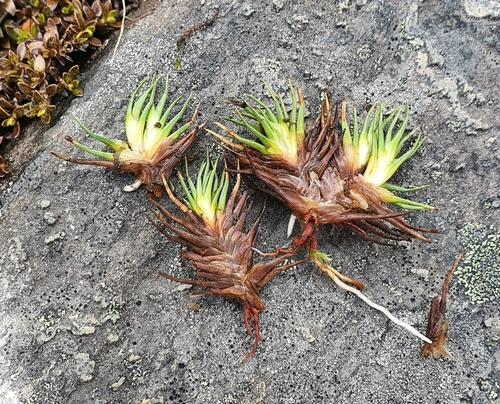
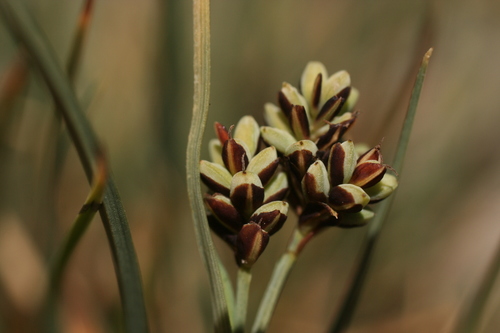
Carex bicolor Bellardi ex All. is a tufted perennial sedge that reaches a height of approximately 7 to 12 cm (3 to 5 in). Most of its grass-like leaves grow from the base of the plant; they are greyish-green, linear in shape, with blades up to 60 mm (2.4 in) long and 1 mm (0.04 in) wide. The leaves have a strong central keel, parallel veins, and long pointed tips. The inflorescence forms on a triangular stem that is roughly the same length as the leaves. It produces two or three spikes of small flowers: the terminal spike has staminate (male) flowers in its lowest third, and pistillate (female) flowers above. The floral scale is shorter than the perigynium that surrounds the achene, with brown or reddish-black edges and a green midvein. Carex bicolor has a pan-boreal distribution. In North America, it occurs across most of Canada, Greenland, Alaska, and the Aleutian Islands. In Northern Europe and Northern Asia, it grows at both low and high altitudes; further south, it is restricted to higher altitudes. Its southernmost range includes the mountains of Spain, France, Italy, Switzerland, and Austria. It is most commonly found in lime-rich habitats, such as moist tundra, the upper edge of beaches, near pools in wet sand, sparsely-vegetated marshes, and patches of moist bare mud. It often grows alongside other sedge species; in Switzerland, its common associates are Carex pallescens, Carex panicea, and Carex vaginata. In the 1940s, botanist John William Heslop-Harrison, Professor of Botany at Durham University, reported discovering Carex bicolor growing on the island of Rùm in the Inner Hebrides, among several other species previously unrecorded in Britain. These discoveries boosted Heslop-Harrison's professional reputation, but the find was later called into question after investigation by classical scholar and botanist John Raven. Raven found that some of the reported species were not present on Rùm at all, while others had only recently been planted on the island. Today, the claim that these plants were indigenous to Rùm is widely considered to be fraudulent.