About Carex baileyi Britton
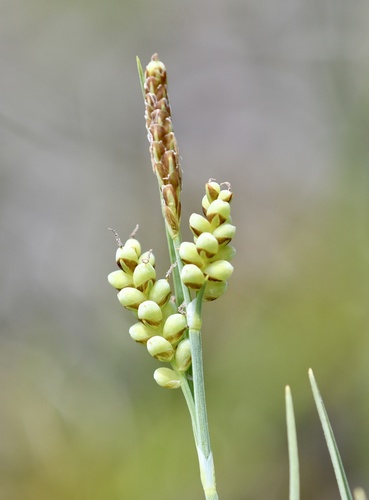
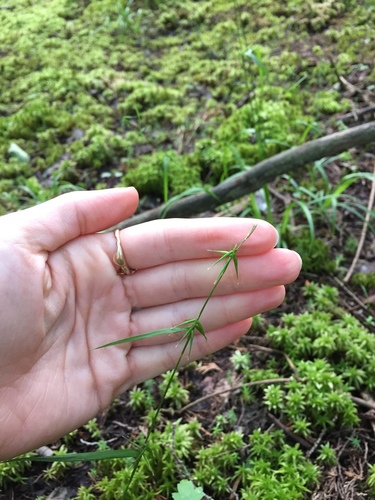
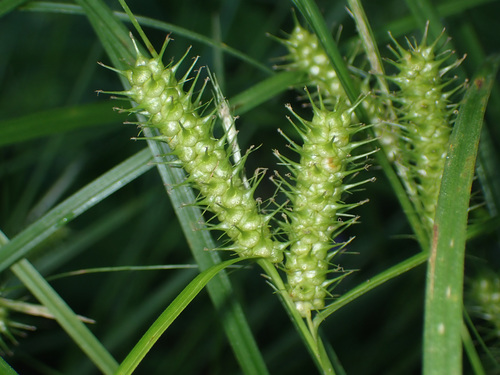
Carex baileyi Britton is a perennial grass-like herb that grows in clumps, similar to bunchgrass. Its stems reach up to 65 cm in height and are triangular, a trait shared with all sedge stems, and the base of each stem is reddish in color. The plant's inflorescence is made up of 1 to 2 female (pistillate) spikes, measuring 10 to 40 mm long by 8 to 13 mm wide, and one male (staminate) spike at the tip of the stem, measuring 15 to 30 mm long by 1.5 to 2.5 mm wide. The male spike is typically upright, while female spikes tend to droop or at least hang horizontally. Like most sedges in the Carex subgenus Carex, the flowers of Carex baileyi have a three-branched pistil, and produce an achene with a triangular cross-section. The perigynia is 5 to 7 mm long, with a long beak that makes up about half of the total perigynia length. The tip of the perigynia beak has two small teeth around 0.5 mm long. The body of the perigynia is inflated around the achene and bears 5 to 9 nerves. The fruits (achenes) are yellow-brown, and measure 1.5 to 2 mm long by 1 mm wide. Below each perigynia is a pistillate scale; this scale is accuminate or rough awned at the tip, and measures between 2.9 to 9.8 mm long by 0.3 to 0.9 mm wide. Carex baileyi is very closely related to the more common Carex lurida, and may be easily confused with this species. The two species overlap significantly in their ranges, but can be distinguished by structural differences: Carex baileyi is more delicate, with smaller leaves and smaller spikes. Specifically, Carex baileyi has spikes that are 0.8 to 1.5 cm thick, and leaves that are 2.4 to 4 mm wide, while Carex lurida has spikes 1.5 to 2.2 cm thick and leaves 4 to 11.5 mm wide. Carex baileyi is an obligate wetland plant that grows exclusively in wetland areas, including swamps, wet woods, sedge meadows, stream shores, and ditches. It tends to prefer growing in acidic soils.