About Carettochelys insculpta Ramsay, 1886
Species Identification
The pig-nosed turtle (Carettochelys insculpta Ramsay, 1886) has a unique combination of traits that sets it apart from all other freshwater turtle species.
Limb Structure
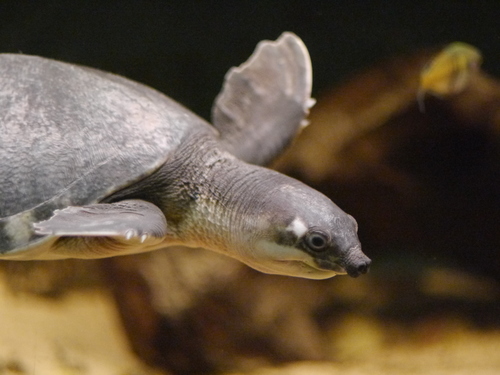
Its feet are flippers, a shape that matches the flippers of marine turtles.
Snout Trait
Its common name comes from its pig-like nose, which has nostrils located at the end of a fleshy snout.
Shell Color and Texture
The turtle's carapace is most often grey or olive, with a leathery texture, while its plastron is cream-colored.
Sexual Dimorphism
Males can be told apart from females by their longer, narrower tails.
Adult Size and Weight
Adult pig-nosed turtles can reach a straight carapace length of around 70 to 75 centimeters (28 to 30 inches), and can weigh over 20 kilograms (44 pounds).
Carapace Comparison to Trionychidae
Unlike soft-shelled turtles in the family Trionychidae, the pig-nosed turtle keeps a domed bony carapace under its leathery skin, instead of the flat carapace plate that trionychids have.
Plastron Comparison to Trionychidae
It also has a solid plastron, connected to the carapace by a strong bony bridge, which differs from the soft margin found on trionychid turtles.
Native Distribution
This species is native to freshwater streams, lagoons, and rivers in Australia's Northern Territory, and also to the island of New Guinea, where it is thought to live in all larger and some smaller southward-flowing rivers.


