About Carduus personata (L.) Jacq.
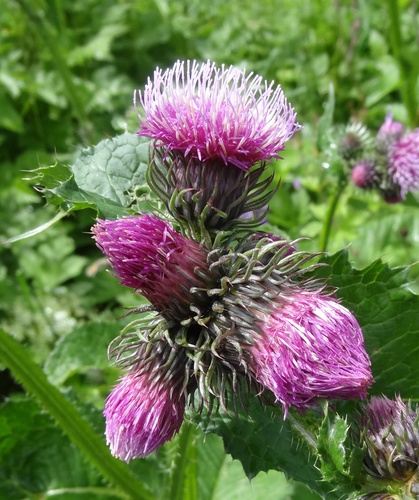
Carduus personata (L.) Jacq. grows from 40 to 160 centimetres (16 to 63 inches) tall, with a sturdy stem that bears short spines. The above-ground portion of the stem is erect, widely branched toward the top, and is tubular, striated, and ribbed, with wings extending all the way to the inflorescence. Soft thorns are present on both the stem and the leaves of this plant. All leaves of this species are cauline and arranged alternately. They are soft, fairly narrow and curly, and pinnately shaped. Lower leaves are broadly shaped and narrow into a petiole, while middle and upper leaves clasp the stem. Middle and upper leaves are lanceolate or ovate-lanceolate, sessile, and have serrated edges. The upper surface of the leaves is hairless or slightly pubescent, while the lower surface is grayish-felted. Lower leaves reach 3 to 4 decimetres (12 to 16 inches) in length and 1 to 2 decimetres (3.9 to 7.9 inches) in width. Median leaves measure 12 to 15 centimetres (4.7 to 5.9 inches) in length and 6 to 10 centimetres (2.4 to 3.9 inches) in width. Two to five sessile flowers are grouped into tightly clustered, even agglomerated inflorescences at the tops of stems. Each flower head has a short, leafy peduncle that supports a hemispheric to ovoidal structure made of multiple bracts. The flowers are violet-purple and 2 to 2.5 centimetres (0.79 to 0.98 inches) in diameter. Both the calyx and the corolla are composed of five parts each. Fruits are bright brown achenes with a glabrous surface, and are approximately 4 millimetres long. This species occurs mainly in the mountains of Central Europe, including the Alps, the Apennines, the Carpathians, the Sudetes, and the Balkans. These plants prefer moist, fertile soils and partial shade, growing in mountain meadows, wet mountain woodlands, debris-covered environments, and along stream banks. In the Alps, they grow at altitudes between 500 and 2,300 metres (1,600 and 7,500 ft).