About Carduus nutans L.
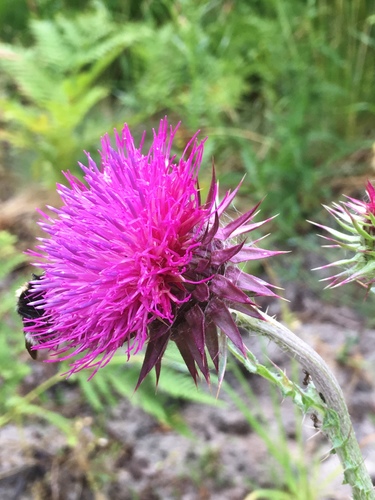
Carduus nutans L. is a monocarpic herb that is generally classified as a biennial thistle, though its phenology can vary depending on climate and habitat. Climate and habitat strongly influence this species' phenology; while it is classified as a biennial, it can also grow as a summer annual, winter annual, or perennial under different environmental conditions. Mature plants can reach 2.7 m (9 ft) tall with multi-branched stems. The stems are cottony/hairy and marked with thin ribs. Plants first develop a basal rosette with large leaves reaching up to approximately 40 centimetres (16 inches) long. Leaves are prickly and jagged, reaching up to 40 cm (1.3 ft) in length. They are dark green, coarsely bipinnately lobed, with a smooth, waxy surface. Sharp yellow-brown to whitish spines grow at the tips of the leaf lobes. Leaves are more or less hairy on the upper surface, and woolly along the veins on the underside. Seeds germinate best between 15 and 30 °C (59 and 86 °F), and thrive in moist soil with alternating day and night temperatures. A single plant produces around 100 seeds per flower, for a total of up to approximately 20,000 seeds per plant. Seeds are mainly dispersed by wind, and can survive in the soil seed bank for up to 20 years. This species is native to Europe, Western Siberia, Asia, and North Africa. It has become invasive in North America, Australia, New Zealand, and Southern Africa, and is especially abundant in the North American Rocky Mountains. It can grow at elevations of at least 1,830 m (6,000 ft). It typically grows in meadows, grasslands, heavily grazed areas such as pastures, and on open disturbed soil such as roadsides and building sites. It grows in neutral to acidic soils, and spreads rapidly in areas affected by frequent natural disturbances like landslides and flooding. It does not grow well in excessively wet, excessively dry, or shady conditions. Carduus nutans has been included in historical herbal decoctions. In Turkish folk medicine, parts of its flowering branches are used to treat prostate disease. It has also been documented as a treatment for liver disease, malaria, constipation, and kidney stones.