About Carduus crispus L.
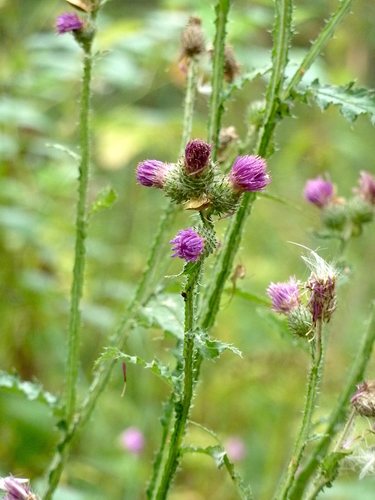
Carduus crispus L. is an upright growing thistle. Individuals can reach up to 3 metres (10 ft) tall, with a more typical height range of 50–180 centimetres (19+1⁄2–71 in). This species begins flowering in May, and its seeds ripen by July; seeds are primarily dispersed by wind. Its leaves are simple, alternate, and grow from the base of the plant; they are never divided into leaflets, and may be either lobed or unlobed. Leaf blade edges can be toothed, lobed, or both toothed and lobed. The upper leaf surface is only sparsely hairy, while the lower leaf surface is covered in white hairs. Leaf blades measure 10–20 centimetres (4–8 in) in length, and the petioles are winged at the leaf base. Unlike most other members of the Asteraceae family, this species has no ray-shaped flowers, producing only disk-shaped flower heads 15 to 18 millimetres (5⁄8 to 3⁄4 in) wide. Flower color ranges from purple and pink to white. Flowers are hermaphrodite, containing both male and female reproductive structures, and are pollinated by insects such as bees. The species produces dry fruits called achenes, which are yellow, or a muted gray-brown color. The flattened, rounded achenes have long unbranched hairs attached to one end to assist with wind dispersal. Carduus crispus is native to Europe and Asia; in Asia, it occurs in Armenia, China, and Hebei. It has become naturalized in Greenland, parts of the United States, Canada, and India. Ecologically, this species requires full sunlight and is not shade tolerant. It needs wet soil with an appropriate pH to grow and thrive. It is classified as a noxious weed in North America, where it is commonly found in pastures and along roadsides. This species and its genus are a favored food source for caterpillars of the painted lady butterfly, Vanessa cardui; the butterfly’s specific epithet cardui comes from this preference for Carduus thistles. Bees also use this plant for honey production. Medicinally, Carduus crispus has documented anti-tumour properties. Its active compound is Crispine B, an alkaloid with cytotoxic effects that stop cancer cells from replicating. The roots of C. crispus are reported to have anodyne, or pain-relieving, properties that reduce perceived pain.