About Cardionema ramosissima (Weinm.) A.Nelson & J.F.Macbr.
Taxonomic Identity
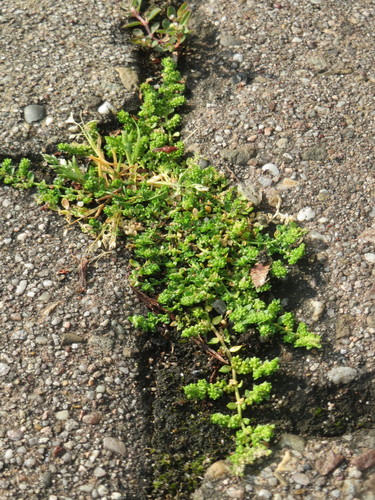
Cardionema ramosissima (Weinm.) A.Nelson & J.F.Macbr. is a prostrate perennial herb.
Stem Characteristics
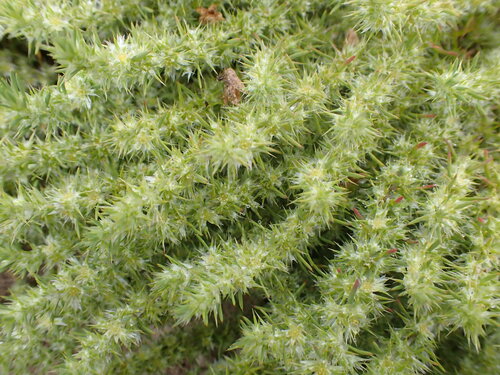
Its stems grow 5 to 30 centimeters (2.0 to 11.8 inches) long and form dense mats, with a pubescent covering of fine hairs across the entire plant. Stems are often hidden by numerous 4 to 8 millimeter (0.16 to 0.31 inch) long stipules that fill the spaces between leaves.
Leaf Morphology
Its leaves are needle-shaped with a fine sharp spine at the tip, measure 5 to 13 millimeters (0.20 to 0.51 inches) long, and are hairless (glabrous).
Inflorescence Traits
The plant produces small, unnoticeable inflorescences that are axillary cymes holding 1 to 5 flowers. The flowers are densely hairy all over, and feature a small cup-shaped hypanthium.
Sepal Features
Each of the 5 sepals has an awn measuring 1.5 to 4 millimeters (0.059 to 0.157 inches) long.
Fruit Characteristics
The fruit is a small, narrowly ovate utricle that is 1.4 to 1.6 millimeters (0.055 to 0.063 inches) long.
Seed Dispersal Mechanism
After fruiting, the sepals harden into a tough, burlike structure that surrounds the utricle to help with seed dispersal.
Habitat and Uses
This dense mat-forming species grows as a thick blanket over sand, and can be used for erosion control on beaches.
General Distribution Pattern
Cardionema ramosissima has a disjunct distribution across both American continents, and approaches an amphitropical distribution pattern but does not technically qualify as such because its range extends into the Andes in the tropics.
North American Coastal Range
In North America, it occurs along the Pacific coast from Puget Sound in Washington, south through Oregon and California, to Baja California as far south as San Quintín. It grows most often directly along the coast, and occasionally grows further inland on hills and dunes.
Introduced Range and Mexico Distribution
It is also considered an introduced species on southern Vancouver Island, British Columbia. It grows throughout central Mexico, specifically in the states of Aguascalientes, Guanajuato, Hidalgo, Jalisco, Mexico, Oaxaca, Puebla, San Luis Potosi, Tlaxcala, Veracruz, and in Mexico City.
Colombian Andes Distribution
In South America, it is found in the Colombian Andes at elevations between 2,600 and 3,125 meters (8,530 to 10,253 feet) in the departments of Boyacá and Cundinamarca.
Ecuadorian Andes Distribution
In the Ecuadorian Andes, it occurs at elevations between 2,000 and 4,500 meters (6,600 to 14,800 feet) in the provinces of Cañar, Chimborazo, Imbabura and Pichincha.
Southern South America Distribution
It is widespread across Chile and Argentina in the Southern Cone of South America, and occurs less commonly in southern Brazil, Uruguay, and Paraguay.