About Cardellina versicolor Salvin, 1863
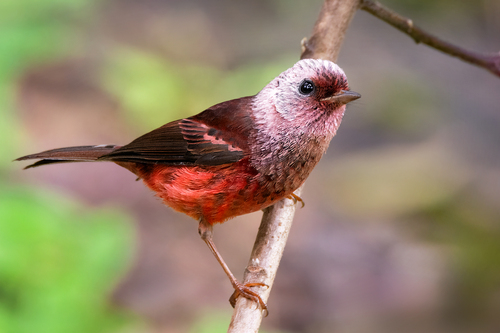
The pink-headed warbler measures 12.5–13.5 cm (4.9–5.3 in) long and weighs 10 g (0.35 oz). Plumage is similar between the sexes, though females are on average slightly duller overall. Adult pink-headed warblers have dark red upperparts, a silvery-pink chest, and pinkish-red underparts. Their head is silvery-pink, with a reddish forehead, dusky lores, and dark brown irises. The bill is blackish, and the lower mandible sometimes shows some horn color; the legs are flesh-colored. Juveniles are rich brown with slightly paler underparts, but this juvenile plumage is molted quickly. By late summer, young birds are virtually indistinguishable from adults — only their unossified skulls can tell them apart. The pink-headed warbler is endemic to the highlands of central and eastern Chiapas, Mexico, and western Guatemala. It is a fairly common to common resident in humid to semi-humid pine-oak, pine-evergreen, and evergreen forest and forest edge, found at altitudes between 1,800–3,500 m (5,900–11,500 ft) above sea level. It prefers forest with a dense, undisturbed understory, but also occurs in disturbed forest with damaged understory in its stronghold areas in Guatemala; this habitat is thought to be suboptimal. While it is counted among the species expected to occur in El Salvador, it has not been reported there to date. Like other New World warblers, the pink-headed warbler is insectivorous. It gleans insects and other invertebrates from vegetation, mostly in dense understory, and makes aerial sallies to catch flying prey. It typically forages between 2–5 m (6.6–16.4 ft) off the ground, and only rarely forages above 7 m (23 ft) — an exception occurs during the breeding season, when males may hunt near the tops of the trees from which they sing, as high as 15 m (49 ft) up. This species often joins mixed-species flocks that pass through its territory. There is some evidence that volcanic eruptions, which can coat vegetation in thick ash and impact insect populations, cause declines in pink-headed warbler populations.