About Cardellina rubra (Swainson, 1827)
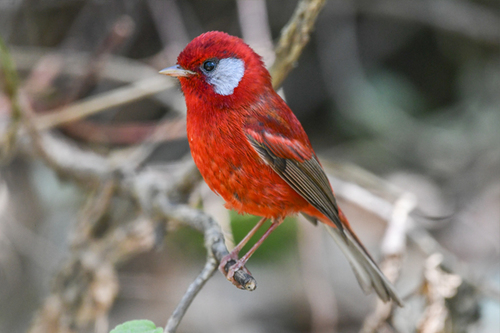
The red warbler, scientifically known as Cardellina rubra (Swainson, 1827), is a small passerine bird. It measures 12.5–13.5 cm (4.9–5.3 in) in length and weighs 7.6 to 8.7 g (0.27 to 0.31 oz). Adult red warblers are red overall, with an auricular patch on each side of the head that is either white or dark gray depending on the subspecies. Their wings and tail are slightly darker dusky red, edged with pinkish-red. Legs are dull red-brown, the thin bill is pinkish-gray with a dark tip, and the iris is dark brown to blackish. Plumage differs very little between males and females, though females tend to be slightly duller or have more of an orange tinge. After the August breeding season, adult pairs separate and undergo a full molt. Within the species' range, adult red warblers are unlikely to be confused with any other bird species. While scarlet tanagers and summer tanagers have similar mostly-red plumage, they are larger and have thick conical bills. Juvenile red warblers are pinkish-brown with a whitish auricular patch. Their darker wings and tail have pinkish-cinnamon edges, and the wings feature two paler wingbars. Red warblers are endemic to the highlands of Mexico located north of the Isthmus of Tehuantepec. The species has three disjunct populations that correspond to its three recognized subspecies: one ranging from southwestern Chihuahua to northern Nayarit, another from southern Jalisco and southern Hidalgo to Oaxaca, and the third from Guerrero into southern Oaxaca in the Sierra Madre del Sur mountains. It is fairly common to common in Mexico's interior and on adjacent slopes, where it occurs at elevations between 1,800 and 3,900 metres (5,900 to 12,800 ft) above sea level, and it is not found along either coast. It is an altitudinal migrant: during the breeding season it lives at higher elevations in humid or semi-humid pine, pine-oak, and fir forests, and moves to lower elevations (often oak forests) for the winter. It is among the most common small birds in its woodland habitat; one study found it was the second most common small bird in fir forests, behind only the golden-crowned kinglet, and another study ranked it as the third most common warbler in oak-conifer woodlands. Though there was a late 19th century report of a collected individual from Texas, the location of this record has not been widely accepted, and there is no strong evidence that the species ever occurred there. A stray red warbler was recorded as far north as southeastern Arizona, found on Mount Lemmon in 2018. In the 16th century, Friar Bernardino de Sahagún reported that a red bird matching the red warbler's description was considered inedible by the Aztecs. Preliminary investigations of red warbler feathers by researchers Patricia Escalante and John W. Daly isolated two alkaloids. The presence of these alkaloids makes the bird unpalatable, so it is inedible to humans. The red warbler is an insectivore. It primarily gleans prey from understory shrubs at low to middle vegetation levels, moving slowly and deliberately through more open vegetation areas. It feeds by making quick jabs into cracks in bark and clusters of pine needles. It sometimes hovers briefly to feed at pine needle clusters, a foraging method called "hover gleaning". Though it has no obvious physical adaptations for climbing, it regularly climbs to search for prey on bark and epiphytes on branches, and often hangs head-down while probing for food. In areas of deciduous growth, it typically engages in flycatching: it makes brief aerial flights from a perch to chase flying insects. It rarely joins mixed-species flocks, but often feeds alongside other birds without conflict and shows no hostility toward species it competes with, such as the slate-throated whitestart (Myioborus miniatus). It has been observed chasing away a flycatcher belonging to the genus Empidonax. Its daily foraging area is quite small, often only a few dozen square meters (several hundred square feet). Late in the afternoon, its foraging rate slows, and it rests (often taking short naps) in the forest understory. While it does not generally feed after sunset, it may do so to take advantage of temporary food sources such as hatching Neuroptera.