About Cardellina pusilla (A.Wilson, 1811)
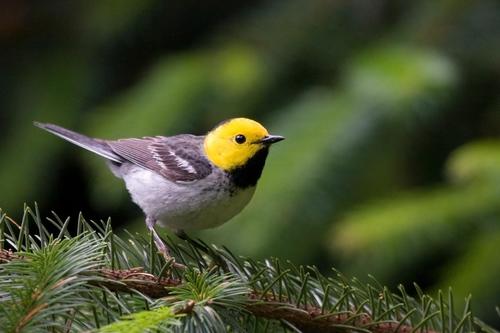
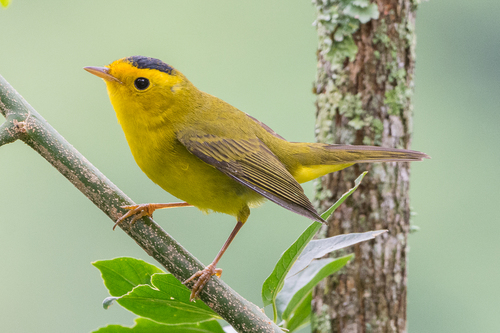
Wilson's warbler (Cardellina pusilla) is a small passerine bird. It measures 10 to 12 cm (3.9 to 4.7 in) in length, has a wingspan of 14–17 cm (5.5–6.7 in), and weighs 5–10 g (0.18–0.35 oz). It has a plain green-brown back and yellow underparts. Males have a small black cap. Males of the western subspecies C. p. chryseola are greener on the upper body and brighter in color than males of the eastern nominate subspecies. Individuals from Alaska and the west-central part of the species' range are on average slightly larger than individuals from eastern and Pacific coastal populations. The song of Wilson's warbler is a chattering series of loud descending notes, and its call is a flat "chuff". Wilson's warbler is similar in appearance to the yellow warbler; yellow warblers are easily distinguished by their different shape, yellow wing markings, and yellow tail spots. The breeding habitat of Wilson's warbler is fairly open woodland with undergrowth or shrubs and thickets in moist areas that contain streams, ponds, bogs, and wet clearings. Wilson's warbler breeds in northern Canada and the western United States; it winters in overgrown clearings, coffee plantations, forest edges, deciduous forests, tropical evergreens, pine-oak forests, mangroves, thorn-scrub, riparian gallery forests, brushy fields, and mixed forests. In all seasons, it prefers secondary growth, riparian habitats, lakes, montane forests, and boreal forests with overgrown clearcuts. It is a very rare vagrant in Western Europe.