About Cardellina canadensis (Linnaeus, 1766)
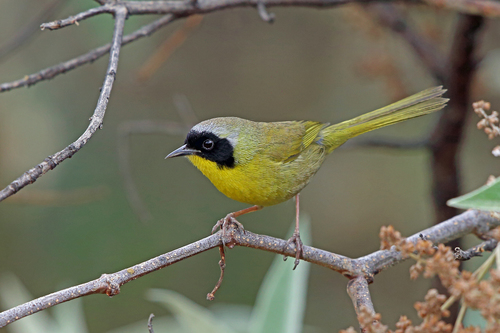
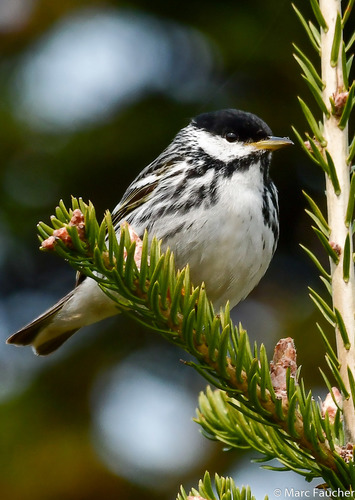
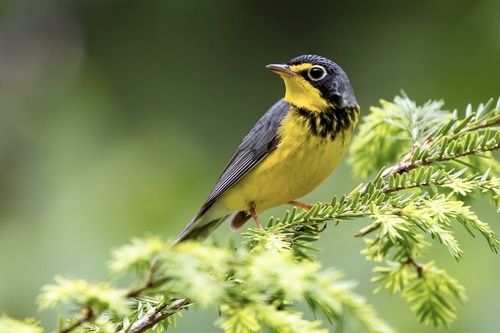
Cardellina canadensis, commonly called the Canada warbler, is sometimes nicknamed the "necklaced warbler" for the band of dark streaks that crosses its chest. Adults show minimal sexual dimorphism: the male's necklace is darker and more noticeable, and males also have longer tails. Full-grown Canada warblers measure 12–15 cm (4.7–5.9 in) in length, have a wingspan of 17–22 cm (6.7–8.7 in), and weigh 9–13 g (0.32–0.46 oz). Their throat, chest, and belly are yellow, and their back is dark grey. They have no wingbars or tail spots, but the underside of their tail is white. They have a yellow stripe running from in front of the eye toward the beak, and their most striking facial feature is white eyerings, also called "spectacles". Immature Canada warblers have similar coloration to adults, but their plumage is duller, and their facial markings are less prominent. During the breeding season, 82% of the global population lives in Canada, and 18% lives in the United States. In Canada, the summer breeding range stretches from southeastern Yukon to Nova Scotia. In the United States, the breeding range extends from northern Minnesota to northern Pennsylvania, east to Long Island, New York. This species also nests in the high Appalachians as far south as Georgia. In winter, the Canada warbler's range runs from Guyana to northwestern Bolivia, along the northern and western side of the Andean crest. Two accidental vagrant individuals have been recorded in Europe: the first was a dying male caught in Sandgerði, Iceland on September 29, 1973, and the second was a first-winter individual, likely female, observed for five days in October 2006 in County Clare, Ireland. In both breeding and winter seasons, the Canada warbler lives in moist thickets. During the breeding season, it nests in riparian thickets, brushy ravines, forest bogs, and similar sites across a wide range of elevations and many forest types. In the northwestern part of its range, it commonly occurs in aspen forests; in the center of its range, it lives in forested wetlands and swamps; and in the southern part of its range, it occupies montane rhododendron thickets. In winter, it prefers habitats at middle to high elevations. A study in northern Minnesota found that Canada warblers live at shrub-forest edges, rather than in mature forests or open fields with shrubs. In New England, the Canada warbler is identified as a "disturbance specialist" that moves into forest patches recovering from wind throw or timber removal. Because it prefers foraging at low heights in deciduous forests, its range is limited at higher elevations where suitable habitat disappears, and it faces competition from the black-throated blue warbler, which prefers similar habitats. The Canada warbler feeds mostly on insects, including beetles, mosquitoes, flies, moths, and smooth caterpillars such as cankerworms. Its diet is supplemented by spiders, snails, worms, and at least seasonally, fruit. It uses multiple foraging tactics: it flushes insects from foliage and catches them mid-flight (doing this more often than other warbler species), and it searches for food on the ground among fallen leaves. When occasionally hover gleaning, males tend to fly at higher heights than females on breeding grounds. In the tropical regions of South America, it forages in mixed-species flocks with other birds, usually 3–30 feet above the ground in dense foliage.