About Cardamine douglassii Britton
Stem Characteristics
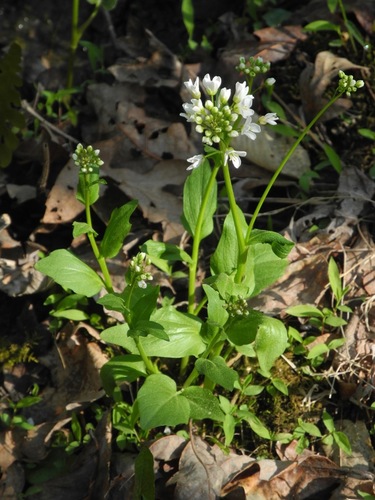
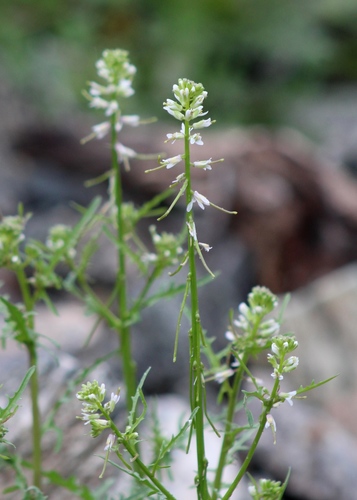
Cardamine douglassii Britton produces an erect, unbranched stem that grows 10 to 25 centimeters (4 to 10 inches) tall, with sparse to dense hair coverage.
Basal Leaf Morphology
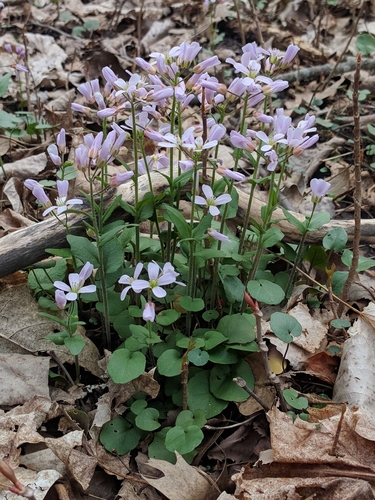
Its basal leaves are simple, heart-shaped or round, measuring 5 to 15 cm (2 to 6 in) across, and grow on petioles 4 to 12 cm (1+1⁄2 to 4+3⁄4 in) long.
Stem Leaf Morphology
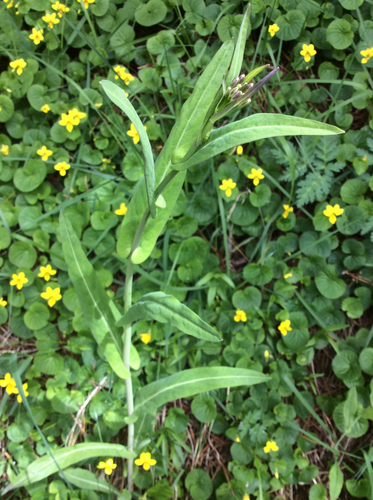
The stem bears 3 to 8 oblong to lanceolate leaves, each 2 to 5 cm (3⁄4 to 2 in) long and 5 to 25 millimeters (1⁄4 to 1 in) wide.
Leaf Margins
Leaf margins can be either smooth or coarsely toothed.
Petal Coloration
Petal color ranges from purple to purplish white, and fully white petals are rare for this species.
Inflorescence and Bloom Period
The flowers grow in a raceme inflorescence and typically bloom from mid-March to late April.
Individual Petal Dimensions
Individual petals measure 7 to 15 mm (1⁄4 to 1⁄2 in) long and 3 to 5 mm wide.
Fruit Morphology
The fruit is linear, 1.5 to 4 cm (1⁄2 to 1+1⁄2 in) long and 1.5 to 2 mm wide.
General Distribution
This species is widely distributed across Ontario, as well as eastern and central United States, though local populations may be scattered.
Detailed Range Extent
Its range extends from Massachusetts west to Ontario, Minnesota, and Missouri, and south to Arkansas, Alabama, and the Carolinas.
Conservation Status
It is listed as an endangered species in Massachusetts, and a species of special concern in Connecticut.
Virginia Habitat
In Virginia, it grows in swamps and forest habitats, generally in base-rich soils.
Threats to Survival
Its survival relies on the presence of suitable habitat, and it can be eliminated from an area by development, changes in land use, or competition with invasive species.