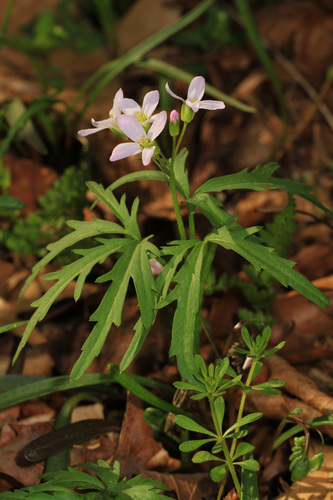
About Cardamine concatenata (Michx.) O.Schwarz
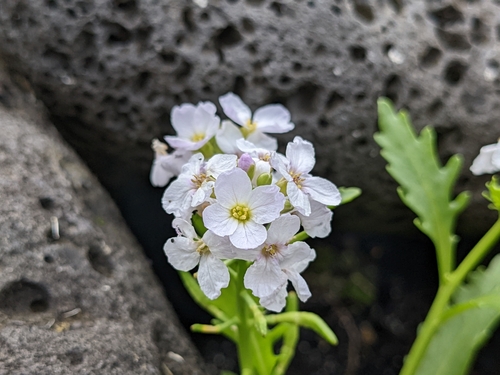
Cardamine concatenata (Michx.) O.Schwarz belongs to the Cardamine concatenata alliance, a distinct species group that also includes Cardamine angustata, Cardamine diphylla, Cardamine dissecta, Cardamine incisa, and Cardamine maxima. All members of this alliance are morphologically similar, sharing an elongated fleshy rhizome and either ternate or palmately compound leaves. The above-ground vegetative structures of Cardamine concatenata grow 20–40 cm tall, and emerge from a segmented rhizome. Its leaves are borne on long petioles, and are deeply palmately dissected into five segments that have large teeth along their margins. White to pinkish flowers are arranged in a spike held above the plant’s foliage. Its fruit is an elongated pod that can grow up to 4 cm long. Like all members of the Cardamine concatenata alliance, Cardamine concatenata is native to eastern North America. It has the widest geographic distribution of any member of the alliance, with a range extending north to Québec and Ontario, south to Florida and Texas, and west to Kansas and Oklahoma. It has been recorded in the following regions: in Canada, it occurs in Ontario and Québec; in the United States, it occurs in Alabama, Arkansas, Connecticut, Delaware, the District of Columbia, Florida, Georgia, Illinois, Indiana, Iowa, Kansas, Kentucky, Louisiana, Maine, Maryland, Massachusetts, Michigan, Minnesota, Mississippi, Missouri, Nebraska, New Hampshire, New Jersey, New York, North Carolina, Ohio, Oklahoma, Pennsylvania, South Carolina, Tennessee, Texas, Vermont, Virginia, West Virginia, and Wisconsin. Across its widespread distribution in the eastern United States, it is present in most counties of Missouri, Illinois, Indiana, and Ohio. It grows in rich deciduous forest habitats, including rich woods, wooded bottomlands, limestone outcrops, rocky banks, and bluffs. Cardamine concatenata blooms from February to May. It acts as a host plant for the imperiled butterfly Pieris virginiensis. For uses, its roots can be washed, chopped, and ground in vinegar to use as a substitute for horseradish. According to Hussey (1974), "the Indians ate the pungent root."