About Cardamine bellidifolia L.
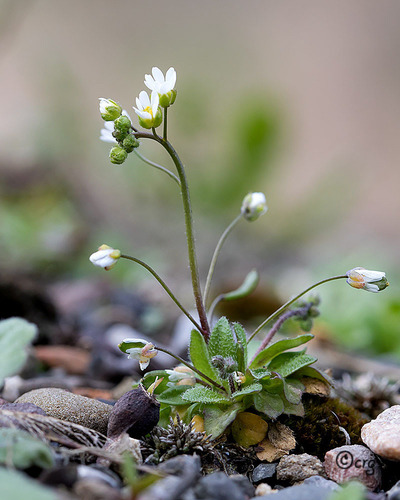
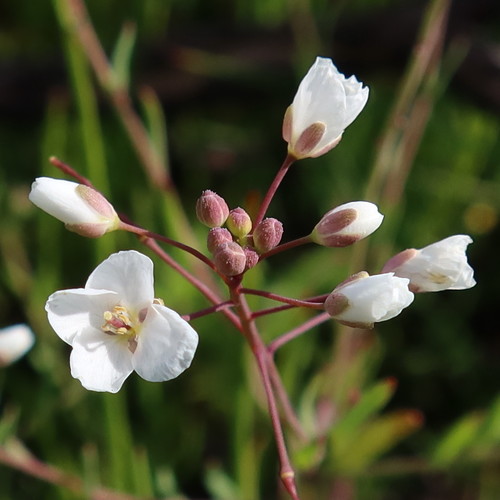
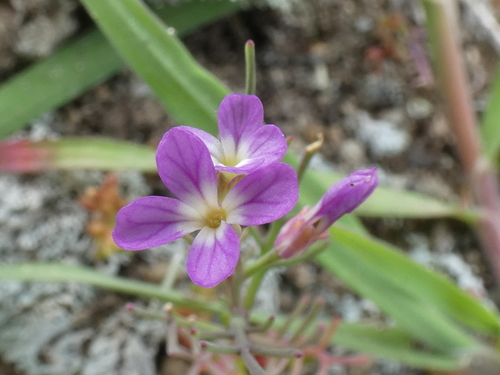
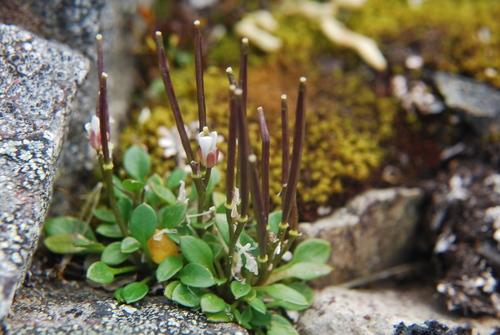
Alpine bittercress (Cardamine bellidifolia L.) grows from a taproot, and has no rhizomes. Stems are erect or ascending, glabrous, somewhat cespitose, and reach roughly 2 to 10 cm (0.8 to 3.9 in) long; the whole plant can grow up to 6 inches tall. Numerous small ovate to oblong leaves, 5 to 30 mm (0.2 to 1.2 in) long with small toothed margins, grow in a basal rosette. Its petioles are 2 to 4 times longer than the leaf blade. Plants may have 1 to 3 cauline leaves, but these are frequently absent. Flower petals are white, oblanceolate, with rounded or notched tips, measuring 4 to 5.5 mm (0.18 to 0.23 in) long and 1.3 to 2 mm (0.05 to 0.08 in) wide. Seeds are oblong, 8 to 18 mm (0.3 to 0.71 in) long and 1.5 to 2 mm (0.06 to 0.08 in) wide. This species flowers from June to September. This species is distributed across North America, Europe, and Asia. In the United States, populations have been recorded in California, Oregon, Washington, Alaska, New Hampshire, and Maine. In Canada, it occurs in Quebec, Newfoundland and Labrador, Nunavut, the Northwest Territories, Yukon, Alberta, and British Columbia. In mainland Europe, it has been found in Spain, France, Germany, Italy, Austria, and Switzerland. It is also native to Greenland, Iceland, and Russia. Globally, it is listed as secure. Conservation status varies regionally: it is vulnerable in Alberta and Labrador, critically imperiled on Newfoundland island, and presumed extirpated from Maine. In New Hampshire, it is unranked, very rare, and restricted to the northern alpine part of the state. In the United States, it is classified as a facultative (FAC) plant, and is labeled facultative wetland (FACW) in the Northcentral and Northeast (NCNE) region. It grows in both wetlands and non-wetlands. Across its range, it favors alpine and subalpine climates, and can be found on or near alpine brooks, cliffs, ravines, rocky slopes, fellfields, and alpine meadows. It grows at elevations between 1800 to 2850 m (5905.5 to 9350.4 ft).