About Carcharodus floccifera (Zeller, 1847)
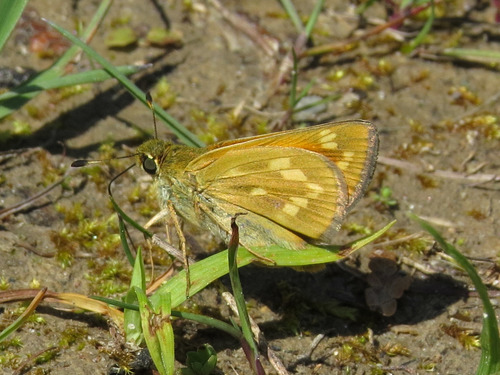
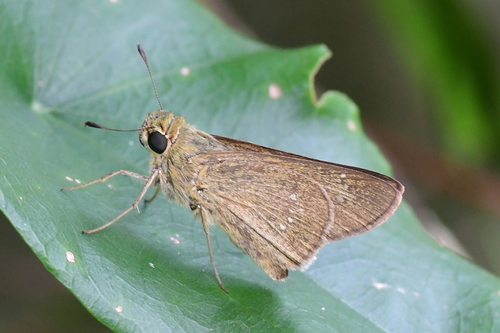
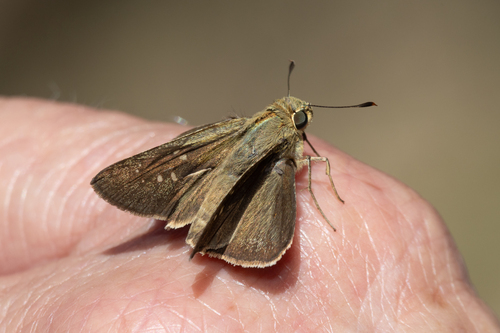
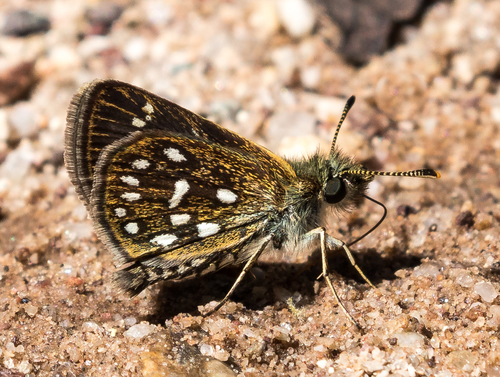
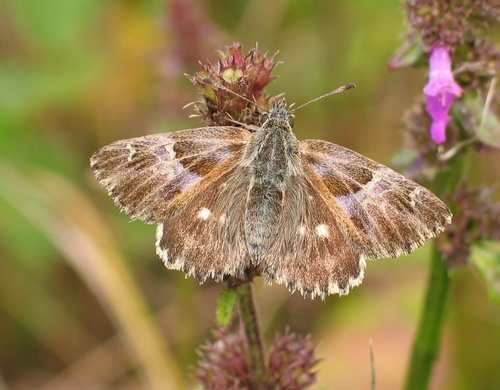
This species, currently scientifically classified as Carcharodus floccifera (Zeller, 1847), is also referenced under the name Muschampia floccifera in this description. It has a wingspan of 32–35 millimetres (1.3–1.4 in). It has a toothed hindwing edge, glass spots on the forewings, and grey-brown patterned wing markings. In central Europe, it can only be confused with Carcharodus alceae, but differs from C. alceae by the clearly protruding white spot at the center of the upper side of the hindwing. Additional characteristic features include radial white marking elements on the outer edge of the underside of the hindwing, and a hair tuft on the underside of the forewings in males. This tuft is often rust-colored, which gave the species its common name. The antennae have a black spot on the top. It is also quite similar in appearance to Muschampia lavatherae and Muschampia orientalis. The relatively compact, strongly hairy caterpillars are initially gray with a black head, and become somewhat brighter as they mature. The pupa is bluish with a black longitudinal stripe on the back of the thorax.
The species' total distribution ranges from the Iberian Peninsula to western Mongolia. In Europe, the current northern border runs through France south of Paris and the Vosges, through the Alpine foothills (formerly through the Rhine-Main area and Danube region), Austria, and further through eastern Poland north to the Baltic States and Russia. In Germany, outside of Bavaria, the species is currently only found in the part of the West Allgäu hill country that borders Baden-Württemberg, and in the Lake Constance basin. Outside of Europe, it occurs in Morocco, Turkey, the Middle East, and extends east across the Palearctic to Siberia. It is not present in the United Kingdom.
In Bavaria, the species lives mainly on extensively used, alternately moist meadows dominated by purple moor grass that support abundant Betonica officinalis, most often on fen soils or moorland. In addition to these purple moor grass dominated meadows, it also occupies relatively dry locations in the Alpine foothills, such as drained peat soils, transition zones between purple moor grass dominated meadows and poor grassland on moraine or drumlin flanks or knolls, and alluvial soils near streams that tend toward semi-arid grassland.
Generally, adults are on wing from May to June or July to September, in two generations. At higher altitudes there is only one generation that flies from June to August. In central Europe, the species usually produces only one generation; a partial second generation occurs in some years. Flight time typically begins in the first ten days of June (sometimes as early as the end of May), usually ends around the middle or end of July, and exceptionally imagos still fly at the beginning of August. The population peak is reached in late June to early July. A partial second generation occurs when caterpillars do not enter diapause as usual in late summer, and instead develop into pupae. Autumn butterflies have rarely been observed in Bavaria from the end of August to the end of September, with several records of individual butterflies from the Bavarian Lake Constance basin or the Passau area.
This is a stationary species with identical habitats for adult imagos and larvae. Adult imagos eagerly visit flowers, with a clear preference for Betonica officinalis, whose main flowering period coincides with the adults' flight period. The butterflies nectar on other plants, especially purple or reddish blooming plants, but do so much less frequently. Betonica officinalis is the only known caterpillar food plant in Bavaria. In the western Alps, caterpillars also feed on the closely related Stachys pradica (=Stachys hirsuta, Betonica pradica). In other parts of the species' range, larvae have also been found feeding on Stachys officinalis, Stachys recta, Stachys alpina, Marrubium (Marrubium vulgare, Marrubium peregrinum), Thymus roegneri and Ballota nigra.
Brown, dome-shaped eggs are usually laid individually on the upper side of leaves close to the ground on non-flowering plants, preferably on the midrib near the leaf base. Two or more eggs can also be found per leaf in favorable locations, though these usually come from clutches of different females. When laying eggs, females clearly prefer well-sunlit open areas within low vegetation. Caterpillars spend their entire lives in self-made leaf webs, just like most skipper species. In the wild, caterpillars have only very rarely been observed feeding outside of their webs. When food demand increases in spring, they occasionally change webs, but usually stay on the same original plant. To overwinter, young caterpillars spin themselves into a very small Betonica leaf at the center of the plant. Pupation often takes place inside the last web made by the caterpillar. To detect this species, searching for eggs or young caterpillars is effective; searchers should pay particular attention to Betonica plants growing in areas with gaps and low-growing vegetation. Larvae overwinter at the base of the host plant.
Unlike most other skipper species, the males of this species show pronounced patrolling behavior when searching for mates. They persistently fly around their habitat, concentrating especially on the flowers of Betonica officinalis. When a male finds a female, a courtship sequence begins: the male strokes the female's antennae with his forewings and attempts to mate after a short intermediate flight. If mating is not successful, this described behavior can be repeated over and over. Based on the few observations made to date, mating lasts approximately one hour. Repeated matings appear to occur: at least one marked female was observed laying eggs first, and later observed in copula.