About Carcharodus alceae tripolina (Verity, 1925)
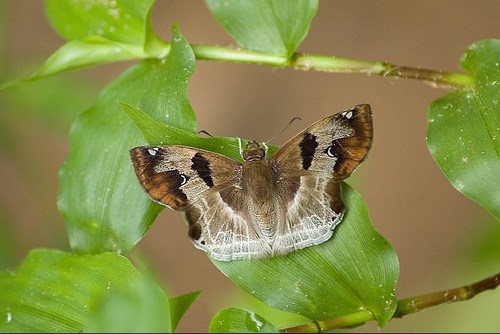
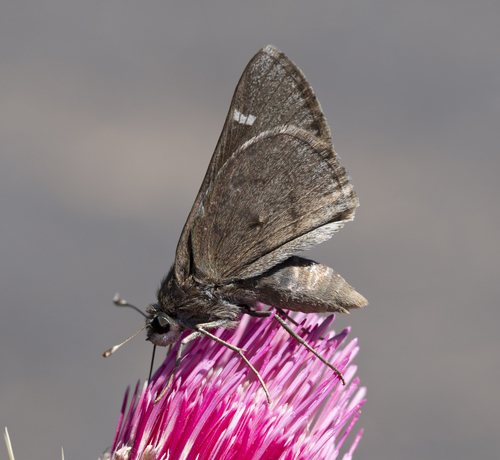
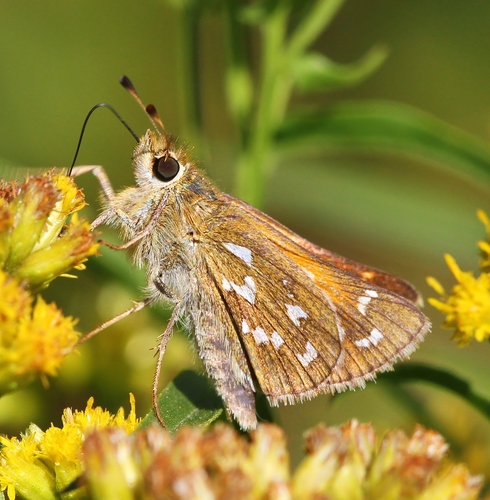
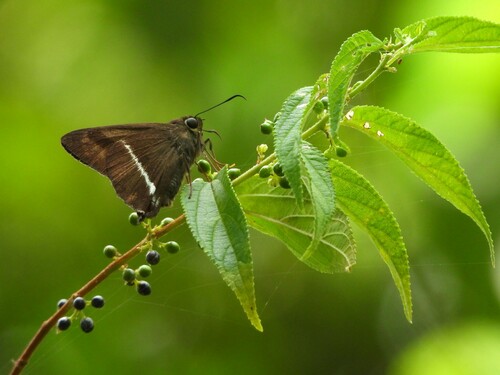
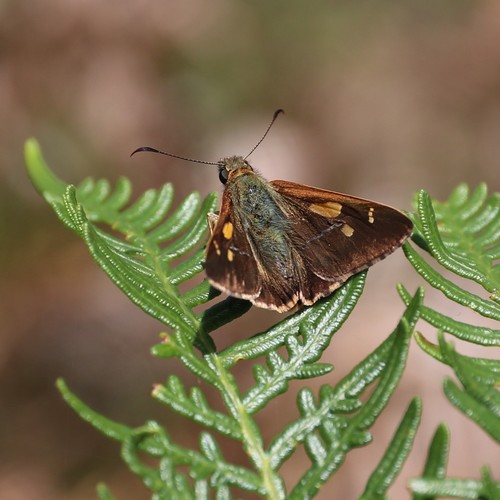
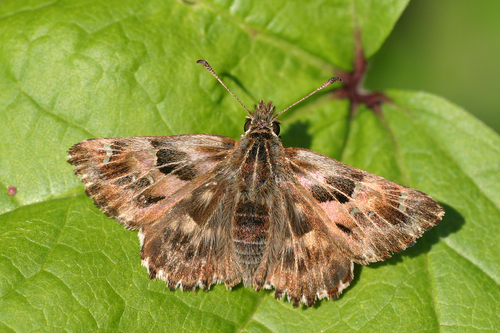
Carcharodus alceae, commonly known as the mallow skipper, has a wingspan of 28–32 mm. The background color of its forewings is pinkish brown, marked with approximately square brown patches, short white transverse stripes starting from the wing edge, and clear patches in the discal area. Its hindwings are brownish or grey-brown, with prominent brighter spots on the underside. Males have no hair tuft on the underside of their forewings. The tips of its antennae are cherry brown. Eggs are yellowish and hemispherical; their surface is covered with elongated warts connected by low ribs, giving the egg a prickly appearance. Eggs turn red as they develop. Fully grown caterpillars reach a length of about 23 millimeters (0.91 in). Caterpillars are dark gray, covered with small white dots and short white hairs. Their head is black with yellow spots separated by black stripes. This species is very similar to the Marbled skipper (Carcharodus lavatherae) and almost indistinguishable from the False mallow skipper (Carcharodus tripolinus). Distinguishing features of Carcharodus alceae include a toothed hind wing edge and small "glass spots" (unscaled areas) on the black-brown basic-colored forewings. The lack of hair tufts on the forewing underside of male Carcharodus alceae allows safe distinction from Carcharodus flocciferus. This widespread and common species occurs from Western Europe to Central Asia. It can be found across most of southern and central Europe, northern Africa (from Morocco east to Tunisia and Libya), the Middle East, Asia Minor, the Caucasus, northern India, Middle and Central Asia, the western Himalayas, and the south of Western Siberia. In Europe, it occurs mainly in the Mediterranean area. In Germany, its regular range extends north to Central Germany, reaching as far as the Kyffhäuser Mountains. Evidence of the species in previously unoccupied areas of Central Europe clearly shows that C. alceae is currently spreading. These butterflies prefer dry, warm, stony areas, wastelands, warm ruderals, and gardens, at elevations up to 1,100 metres (3,600 ft) above sea level. In Bavaria, its altitudinal distribution ranges from about 100 m to 600 m, with the core population in the Colline zone between 200 m and 500 m elevation. Its habitat consists of a wide range of grassland habitats and ruderal meadows that support mallow species, the larval host plants. In Middle and Southern Franconian Jura, it occupies uneven limestone areas, sandy grasslands, ruderal embankments, and other thermophilic ruderal meadows. Additional habitats include fallow land (especially industrial wasteland), roadsides, and arable fields sown with seed mixtures. Oviposition regularly occurs in gardens and on vineyard edges. In limestone grasslands, the species uses sites with patchy, disturbed vegetation such as limestone rubble areas, seams, or marginal transition zones adjacent to fields. In recent years, numerous observations have been made in freshly cleared limestone grasslands over open bare ground, where mallow species temporarily grow in higher numbers. The powerful-flying adult butterflies can readily colonize newly created habitats very quickly, often needing only a single mallow plant to establish. For example, in the Neumarkt / Oberpfalz district of Germany, the species (both adult butterflies and caterpillars) has been detected in almost all larger grassland areas over the past ten years, though mostly at low densities. Although adult butterflies are strong fliers capable of rapid spread, they are most often observed near their larval habitats. The easily recognizable folded, spun leaf "bags" are a clear indicator of this species' caterpillars. Their presence in gardens meant the larval lifestyle of C. alceae was already known to Maria Sibylla Merian in the 17th century. Multiple caterpillars are often found on a single plant at the same time. Mallow skippers lay their eggs on the upper surface of leaves of various mallow species, which gives the species its common name. Larvae feed mainly on Malva alcea, Malva sylvestris, Malva moschata, Althaea officinalis, Lavatera thuringiaca, and Hibiscus species. Which of these species are preferred regionally depends mostly on their local distribution and frequency. Oviposition on Malva neglecta has been recorded at arid sites in the Middle Jura and on vineyard edges in the Steigerwald. On embankments of the Rhine-Main-Danube Canal, the abundant local Lavatera thuringiaca is accepted as a food plant. Additional recorded host plants include Althaea officinalis and Alcea rosea. In Bavaria, caterpillars can be found from May 12 to September 23. Peak caterpillar occurrence falls in the second half of August, and caterpillars are documented almost continuously throughout this period except for the last ten days of June and the first and last ten days of July. Fully grown caterpillars stop feeding, overwinter, and pupate the following spring. Caterpillars do not overwinter on their food plants, and the exact location where they spend the cold season is currently unknown, though they are presumed to overwinter in plant litter. Adult butterflies feed on nectar from various herbaceous plants, particularly tall herbs and mallow species themselves. Adults often suck moisture from damp spots on unpaved roads. Adults fly from April to October depending on location. In Central Europe, this species typically has two generations, flying in April–May and July. In southern areas, there are three or more generations per year. Flight timing depends heavily on annual weather conditions, ranging from mid-April to early September. First-generation adults are mainly observed in May. The transition between the first and second generation is fluid across all years of observation, but butterfly counts drop significantly in early to mid-June. More second-generation individuals begin to appear from early to mid-July, and this generation is usually much more numerous than the first. Butterfly observations decline starting from mid-August.