About Caradrina selini Boisduval, 1840
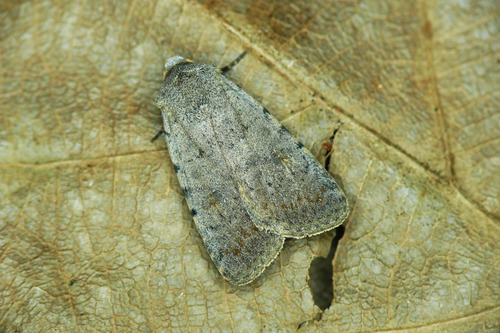
Caradrina selini is a species of moth in the Noctuidae family. It was first described by Jean Baptiste Boisduval in 1840, and its scientific name is Caradrina selini Boisduval, 1840. This moth can be found across most of Europe, as well as in North Africa and the Near East. Male individuals have a wingspan ranging from 25 to 29 millimeters, while female individuals have a slightly larger wingspan of 25 to 30 millimeters. Adult moths are active on the wing between May and August each year. The upper surface of the forewing has a base color that ranges from blue-gray and ash-gray to brown-gray. Several dark spots are clearly visible against the moth’s slightly lighter forewing front edge. The reniform spot is usually unclear, and the annular spot is reduced to just a small black dot. The transverse lines on the forewing are dark in color, but are also usually indistinct. The upper surface of the hindwing is unmarked, whitish in overall color, and darkens slightly toward the wing edge. The larvae of Caradrina selini feed on a variety of low-growing plant species, including species in the genera Plantago, Rumex, and Taraxacum.