About Carabus violaceus Linnaeus, 1758
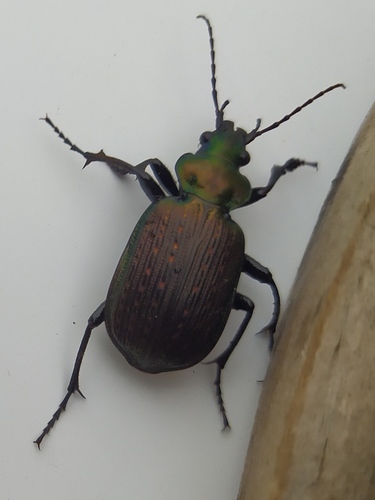
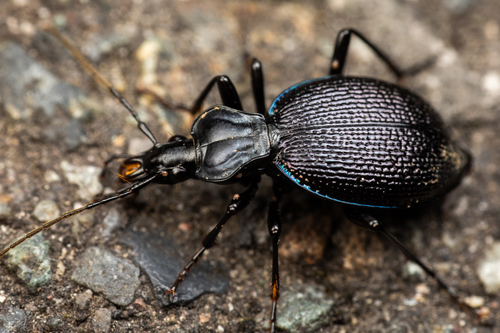
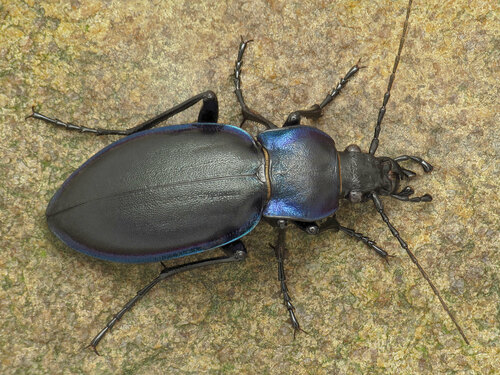
Violet ground beetles (Carabus violaceus Linnaeus, 1758) are flightless beetles with a black head, thorax, and abdomen that have purple lateral margins. Their underside, antennae, and legs are all black. Antennae reach half the total body length. The thorax is nearly heart-shaped, scalloped along its front edge, and bordered at the back. The elytra are joined, smooth, and lack ridges or indentations, but do feature tiny bumps arranged in indistinct lines. Adult body length typically ranges between 2 and 3 centimetres (0.79 and 1.18 inches). This species looks very similar to Carabus problematicus, but purple colouration on the pronotum of C. violaceus covers a more extensive area. The species is distributed across the Euro-Siberian region, and is common throughout Great Britain. Violet ground beetles inhabit both ancient and recent woodlands, as well as some adjacent habitats. Because they are flightless and restricted to forested habitats, they have low dispersal ability and are vulnerable to habitat fragmentation; one study found that just a few kilometres of grassland was enough to prevent these beetles from settling in forests located on the other side of the grassland. One subspecies, C. violaceus picens, is known to live in high-altitude pastures. Examinations of stomach contents have confirmed that jackdaws sometimes feed violet ground beetles (along with other insects) to their nestlings, and blackbirds also sometimes eat this beetle species.