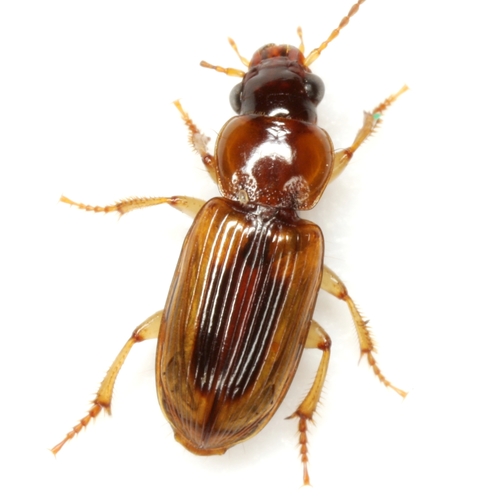
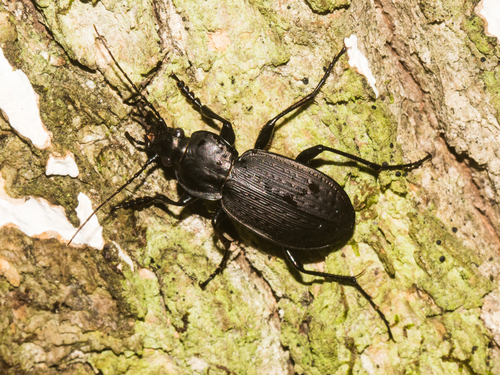
About Carabus insulicola Chaudoir, 1869
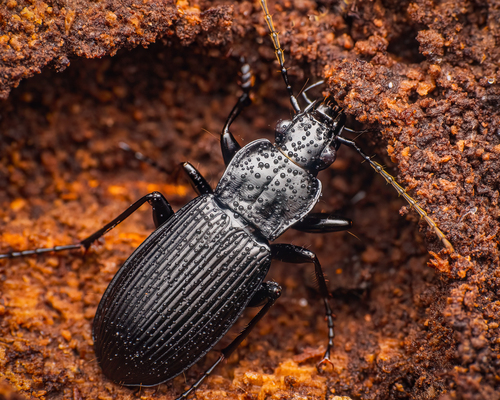
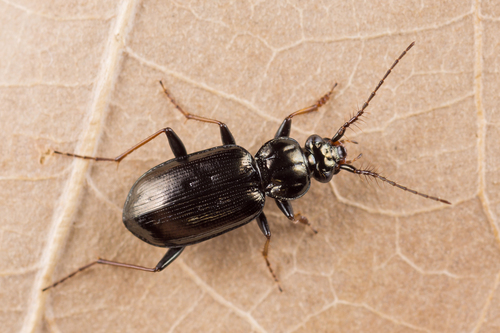
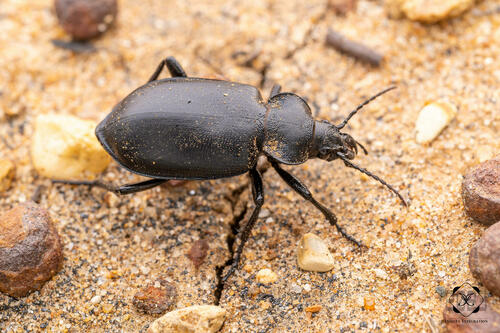
The scientific name of this species is Carabus insulicola Chaudoir, 1869.
Male genitalia of Carabus insulicola are composed of an endophallus, aedeagus, and a copulatory piece. The copulatory piece is highly sclerotized, shaped like a hook, and attached to the dorsal wall of the endophallus. The spermatophore, a hemispherical capsule that holds sperm, is deposited through an opening at the end of the endophallus called the gonopore. Female genitalia are made up of a bursa copulatrix, dorsal lobe, spermatheca, oviduct, vaginal apophysis, and a vaginal appendix. The vaginal appendix is a pocket attached to the bursa copulatrix. During copulation, the copulatory piece and the vaginal appendix are the structures that directly couple together. The bursa copulatrix stores and digests the spermatophore. The spermatheca is a thin tube-shaped structure that stores sperm obtained from the spermatophore as it digests in the bursa copulatrix, and uses that stored sperm to fertilize eggs. Sperm can only be transferred to the spermatheca when the spermatophore is positioned at the innermost corner of the bursa copulatrix and attached to the vaginal apophysis.
C. insulicola is an example of a species that evolved sexually antagonistic genitalia. Research shows males evolved longer copulatory pieces to improve their reproductive success: longer copulatory pieces can displace spermatophores previously deposited by rival males. However, females experience a fitness cost when mating with males that have long copulatory pieces, which causes females to lay unfertilized eggs, a behavior called egg dumping. In response to this cost, females evolved longer vaginal appendixes. A longer vaginal appendix reduces the female's fitness cost by lowering rates of egg dumping and increasing fertilization success. Thus, longer copulatory pieces improve male fitness at the expense of female fitness, while longer vaginal appendixes improve female fitness at the expense of male reproductive success. This evolutionary tug of war leads to coevolutionary divergence of male and female genitalia in C. insulicola. Still, the better the lengths of the copulatory piece and vaginal appendix match one another, the more successful insemination will be.
This beetle species is endemic to Japan, distributed across central and northeastern Honshu. They typically live in lowland habitats including grasslands, open forests, riverbanks, and forest edges. Adults can be found under leaves, within soil, or moving across the ground. Larvae live under objects and debris on the ground, while pupae develop in soil cells buried a few inches underground.
There are four distinct stages in this ground beetle's lifespan: egg, larval, pupal, and adult stage. Eggs are laid in moist soil, are elliptical in shape, reach approximately 6.6 mm in length, and take about eleven days to hatch. A single clutch can contain anywhere from 30 to 600 eggs. After hatching, larvae feed and grow for about one year until they reach maturity. Larvae mature during the summer, then pupate inside soil chambers. Because the pupal stage takes place underground, pupae are rarely observed. Adults emerge from the pupal stage between late summer and autumn, then hibernate through the winter without mating. These overwintered unmated adults emerge in spring, when they are ready to mate and reproduce. C. insulicola is univoltine, meaning it produces one generation of offspring per year. Individual ground beetles can live up to 2 to 3 years.
C. insulicola are predatory beetles. They primarily hunt and feed on smaller invertebrates, including snails, earthworms, and caterpillars. Adults feed on all of these invertebrate groups, while larvae only consume earthworms. In laboratory settings, C. insulicola can be fed minced beef and chopped apples to approximate their natural diet.