About Carabus auronitens Fabricius, 1792
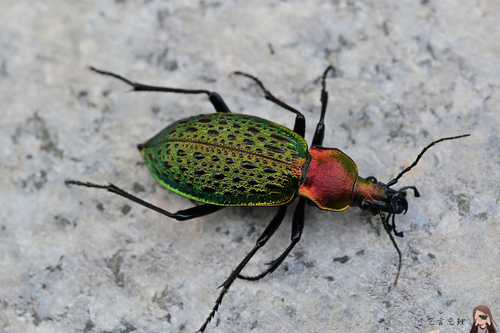
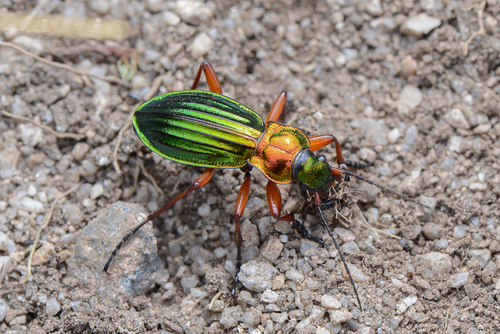
Carabus auronitens Fabricius, 1792 is a ground beetle species that reaches 18–32 millimetres (0.71–1.26 in) in length. Its elytra and head are shiny, with highly variable coloration across individual specimens: most often red golden or red green, and more rarely blue. The prothorax is reddish copper in color and narrow at its base. Each elytron has a granular surface marked by three sturdy, dark longitudinal veins. Legs are black, except for the red femora. Antennae are also black, with red on their base segments. This species can be told apart from the closely related Carabus auratus by its veins and antennae: Carabus auratus has green-gold elytral veins and red on its first four antenna segments. This species occurs across central, eastern and western Europe. It is absent from northern Europe, and from areas south of the Pyrenees in western Europe. It inhabits humid, cool deciduous and mixed forests, as well as unwooded areas at high elevations. It can be found under loose bark, in dead wood, and in bogs, occurring from low western European plains up to 2,500 metres (8,200 ft) in mountains and forelands. Adult beetles are active from May to September. Adult Carabus auronitens are primarily nocturnal, and prey on small animals including snails, worms, and insects. After three moults, larvae climb trees to heights of around 7 metres (23 ft) to pupate. New adults hatch in late summer or early autumn, then overwinter under bark, in gaps in dead wood, and in tree stumps, becoming active the following year.