About Capsiempis flaveola (Lichtenstein, 1823)
Scientific name: Capsiempis flaveola (Lichtenstein, 1823).
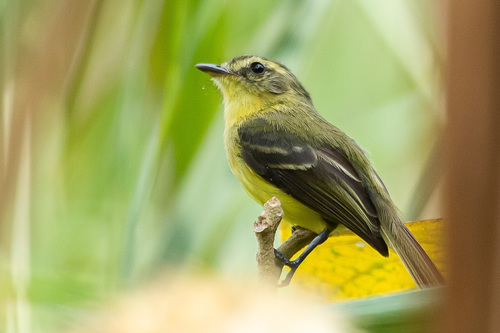
Description: The yellow tyrannulet measures 10 to 11.5 cm (3.9 to 4.5 in) long and weighs approximately 8 grams (0.28 oz). Males and females have identical plumage. Adults of the nominate subspecies C. f. flaveola have a dark yellowish olive crown with a somewhat bushy crest. Their face is mostly yellowish, marked with a bright yellow supercilium, a bright yellow partial eye ring, and a dark line running through the eye. Their upperparts are dark yellowish olive. Their wings and tail are dusky olive, with pale yellow to buffy yellow edges on the flight feathers, and pale yellow to buffy yellow tips on the wing coverts. The tipped wing coverts form two wide but indistinct wing bars. Their throat and underparts are bright yellow, with an ochraceous tinge across most of the breast and an olive tinge on the breast sides.
The species' four other subspecies differ from the nominate in consistent traits. Subspecies C. f. semiflava has much paler yellow underparts and somewhat more distinct wing bars than the nominate. C. f. leucophrys is the largest subspecies and has the longest bill; it has a mostly white supercilium and a whitish throat. C. f. cerula is the second largest subspecies after C. f. leucophrys, and resembles it, but has an entirely yellow supercilium matching that of the nominate. C. f. magnirostris has the thickest bill of all subspecies; it is otherwise identical to the nominate except for a paler yellow supercilium.
Both sexes of all subspecies have a dark brown iris, a longish and slightly curved black bill with a pale base to the lower mandible, and dark gray legs and feet.
Distribution and habitat: The yellow tyrannulet has a highly disjunct distribution, with each subspecies occupying a separate range. C. f. semiflava is found on the Caribbean slope from southeastern Nicaragua south through Costa Rica, extending slightly into Panama; on the Pacific slope from Costa Rica's San José and central Puntarenas provinces into Panama, ranging along both coasts to eastern Colón and Panamá provinces; and on Panama's Isla Coiba. There is also a single recorded sighting of this subspecies in Honduras. C. f. cerula occurs in Colombia and Venezuela east of the Andes, ranging east through the Guianas into northern Brazil's Amapá state, south into northeastern Ecuador, south into central Amazonian Brazil, and south through western Amazonian Brazil into northeastern Peru; it is also found locally in southeastern Peru and northern Bolivia. C. f. leucophrys ranges from Colombia's Magdalena River valley and Sucre Department east into northwestern Venezuela, through Zulia and Táchira states to southwestern Lara state. C. f. magnirostris is found in west-central Ecuador, from western Pichincha Province south to Guayas and El Oro provinces. The nominate subspecies C. f. flaveola occurs in southeastern Bolivia, eastern and southeastern Brazil as far north as Paraíba and as far south as Rio Grande do Sul, eastern Paraguay, and Misiones Province in northeastern Argentina.
The yellow tyrannulet lives in a variety of humid lowland landscapes, mostly within the tropical zone. It mostly occupies habitats of somewhat low vegetation stature, and avoids the interior of tall closed forest. It can be found in dense thickets and vine tangles in forest clearings, around lakes, along watercourses, and especially favors stands of bamboo. It also occurs in dense secondary forest, scrubby overgrown pastures, coffee plantations, and mangroves. In some regions it lives in gallery forest, and in Brazil it can be found in restinga. Its maximum elevation range varies by location: it reaches 600 m (2,000 ft) on Costa Rica's Caribbean slope, 1,200 m (3,900 ft) on Costa Rica's Pacific slope, 800 m (2,600 ft) in Colombia, 1,500 m (4,900 ft) in Ecuador, 1,150 m (3,800 ft) in Peru, 600 m (2,000 ft) in western Venezuela, 300 m (1,000 ft) in eastern Venezuela, and 1,500 m (4,900 ft) in Brazil.