About Capsella bursa-pastoris (L.) Medik.
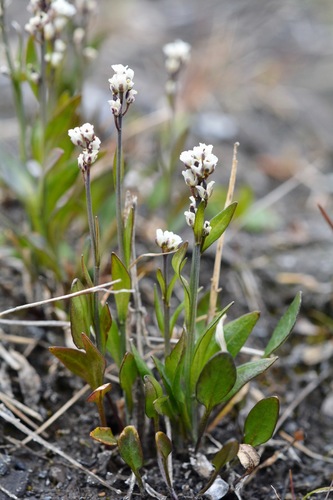
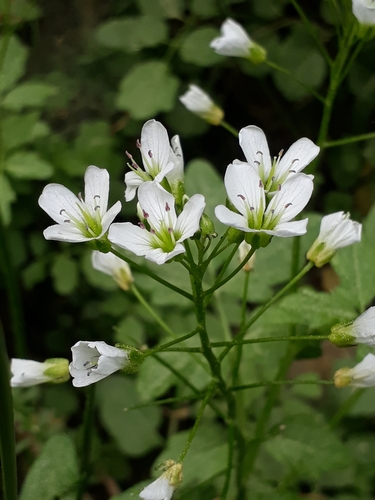
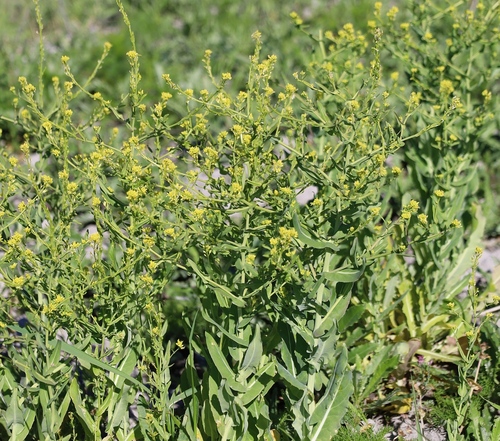
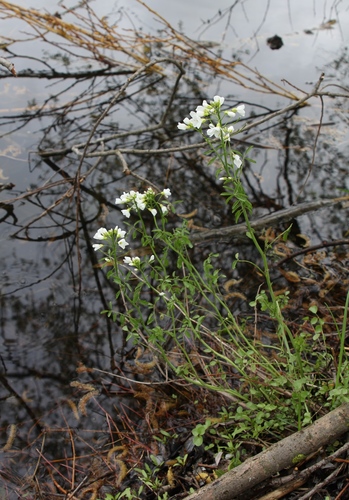
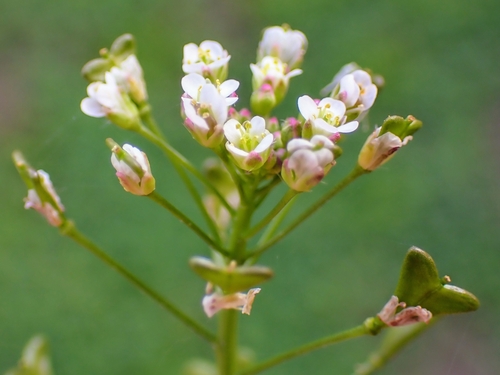
Capsella bursa-pastoris (L.) Medik. is an annual or biennial ruderal plant. It grows from a basal rosette of lobed leaves. A stem emerges from this base, most often reaching 10–50 cm (4–20 in) in height, but occasionally growing as tall as 70 cm (28 in) or remaining as short as 2 cm (3⁄4 in). This stem bears a small number of pointed leaves that partially clasp it, and each stem leaf can grow up to 6.5 cm (2+1⁄2 in) long. In the British Isles, its small white flowers can appear in any month of the year. Each flower is 2.5 mm (1⁄8 in) in diameter, with four petals and six stamens. Flowers are arranged in loose racemes, and develop into flattened, two-chambered seed pods called silicles. These seed pods are about 6 mm long, shaped triangular to heart-shaped, and each holds several seeds. This species is native to eastern Europe and Asia Minor, but has become naturalized and is considered a common weed across many parts of the world, particularly in colder climates. It is classified as an archaeophyte in the British Isles, and is also widespread as a naturalized weed in North America, China, the Mediterranean, and North Africa. C. bursa-pastoris is the second-most prolific wild plant in the world, and grows commonly on cultivated ground, along waysides, and in meadows. Known pathogens that infect this plant include the white rust Albugo candida, the downy mildew species Hyaloperonospora parasitica, and Phoma herbarum. Capsella bursa-pastoris, whether gathered from the wild or intentionally cultivated, has multiple uses. It is used as food, a supplement to animal feed, an ingredient in cosmetics, and as a plant in traditional medicine where it is reportedly used to stop bleeding. The plant can be eaten raw, and its leaves are best when harvested young. Native Americans ground the plant into meal and made a beverage from it.