About Caprona alida (de Nicéville, 1891)
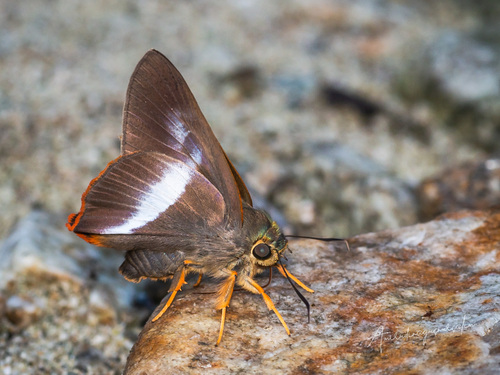
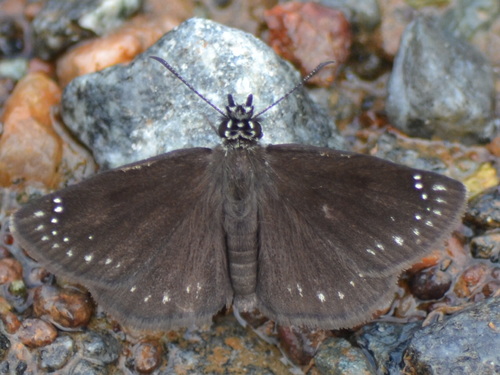
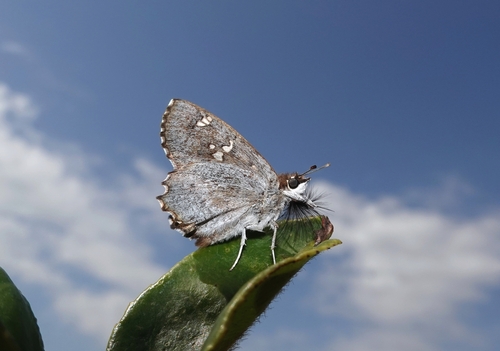
This description covers Caprona alida, originally described by de Nicéville in 1891, starting with the male. On the upper side of the male wings, the base color is ochreous-brown. The forewing has five sub-apical white spots: the three closest to the costa sit in a straight outwardly oblique line, and the two lower spots are very small, and sometimes absent. All other spots and dots on the forewing are white and semi-hyaline: a small round dot within the cell before its middle; a spot within the outer end of the cell, which is deeply excavated on its outer side, leaving only a short curved streak for its upper half; a round spot in the middle of the first median interspace; a round dot outside this spot, towards the base of the second median interspace; a minute dot immediately below the lower spot, and a small round spot positioned inwardly below the minute dot, with both of these located in the interno-median interspace; and a very minute dot close to the costa at its middle. Additionally, the forewing has an indistinct narrow brown bar across the interno-median interspace before the middle, and an indistinct, irregular, recurved brown lunular discal line. The hindwing has indistinct, lunular brown discal and sub-marginal lines. Both wings have a brown outer marginal line and white cilia, with small brown patches at the ends of the veins. On the underside, the base color is pale brown, and the spots and markings match those on the upper side. Both wings are covered and smeared with white scaling; the outer marginal line is brown, with a small amount of brown suffusion on its inner side. On the antennae, the underside of the upper half of the club is ochreous, there is a white streak on the lower half of the club, and the shaft bears white dots. The palpi, underside of the body, and legs are white. The head and upper side of the body match the wing color, and there is a white spot on each side of the head. Females are similar to males, but have a duller base color on the upper side, far less white scaling on the underside, and have a rather broad, indistinct brownish fascia across the disc of the forewing on the underside.