About Cantharellus lateritius (Berk.) Singer
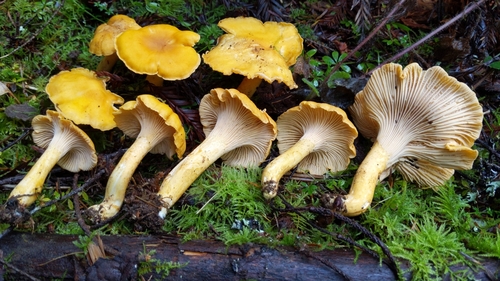
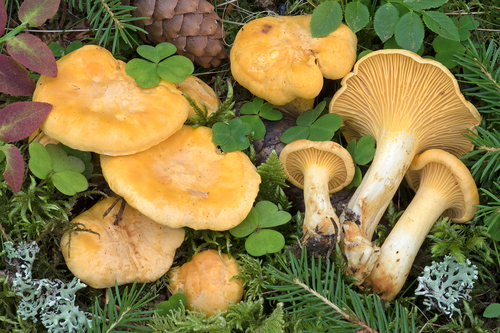
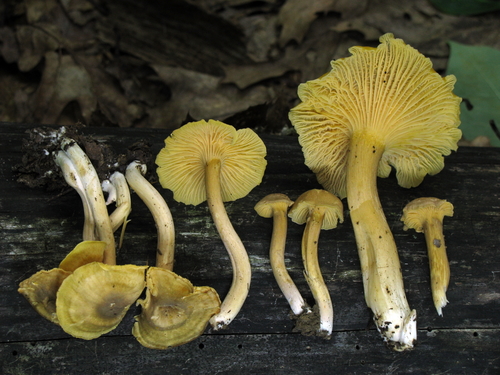
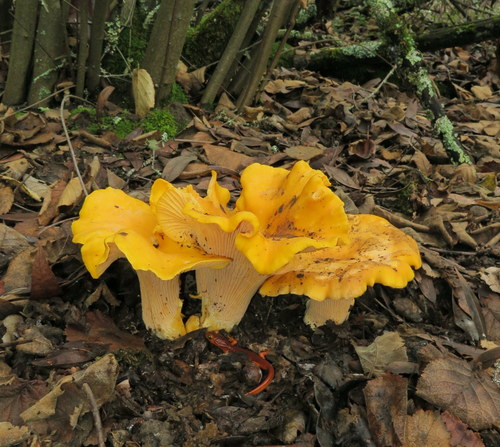
Cantharellus lateritius (Berk.) Singer, a species of chanterelle, has fruiting body caps that typically measure 2 to 12 cm (3⁄4 to 4+3⁄4 in) in diameter. Caps have a flattened to somewhat funnel-shaped top surface and a wavy margin. The cap surface is dry, slightly tomentose (covered with a layer of fine hairs), and deep bright orange-yellow; older specimens fade to more yellow with age. The cap's distinctive margin is paler yellow, and typically curves downward in young fruiting bodies. Mature fruiting bodies can reach a total height of 12 cm (4+3⁄4 in).
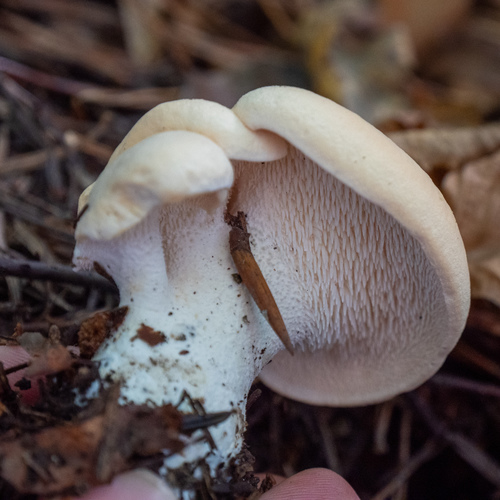
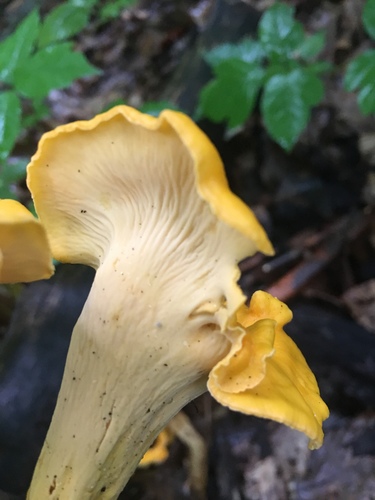
The hymenophore, the spore-bearing surface, is initially smooth and wrinkle-free, but gradually develops channels, ridges, and shallow vein-like gills less than 1 mm wide. It is pale yellow, and its surface connects continuously to the surface of the stem.
The stem is relatively plump and stout, measuring 1.5 to 10 cm (1⁄2 to 4 in) long and 0.5 to 2 cm (1⁄4 to 3⁄4 in) thick. It is roughly cylindrical, tapering downward toward its base, which is sometimes white. Internally, stems are either stuffed (filled with cotton-like mycelia) or solid. Rarely, fruiting bodies may grow clumped together with stems joined at the base, with usually no more than three fused stems per cluster.
The flesh is solid to partly hollow (sometimes hollowed by insect larvae), pale yellow in color, and 0.5 to 0.9 cm (1⁄4 to 3⁄8 in) thick. Spores are smooth, roughly ellipsoid in shape, with typical dimensions of 7–7.5 by 4.5–5 μm. In a spore print deposit, spores are light yellow-orange, while they appear very pale yellowish under magnification. The spore-bearing cells, called basidia, measure 75–80 by 7–9 μm, produce 4 to 6 spores each, are slightly club-shaped, and have a distinctly thickened wall at the base. Clamp connections — short branches connecting cells to allow passage of nuclear division products — are present in the hyphae of all parts of the fruiting body.
Cantharellus lateritius is distributed in North America, Africa, Malaysia, and the Himalayas, specifically the Almora hills in Uttar Pradesh. In North America, it appears from June to September, and its range in the United States extends north to Michigan and New England. It typically grows solitary, in groups, or in clusters under hardwood trees, and produces fruiting bodies in summer and autumn. In New England (United States), mycologist Howard Bigelow recorded it growing on road shoulders in grass near oaks, and noted it also tends to grow on sloping creek banks. In Malaysia, it is found growing on soil in forests, mostly under Shorea species, which are rainforest trees in the family Dipterocarpaceae. It has also been reported from the Western Ghats, Kerala, India, where it forms ectomycorrhizal associations with endemic tree species including Vateria indica, Hopea parviflora, Diospyros malabarica, and Myristica malabarica in semi-evergreen to evergreen forests.