About Canarina canariensis (L.) Vatke
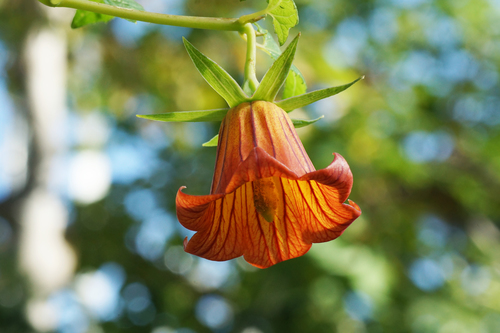
Canarina canariensis (L.) Vatke is a scrambling herbaceous perennial plant. It has glabrous (smooth), glaucous (grey-green) leaves that are opposite, petiolate, triangular or hastate with toothed (dentate) margins. Latex is present, and stipules are absent. Its flowers are axillary, solitary, and bell-shaped, measuring 3–6 cm long, and are orange, darkening when dried. The plant grows from a thick tuberous root, which produces hollow, scrambling stems around 3 m long each year. Its fruit is a large, ovate, fleshy berry that is orange and edible when ripe. This species is bird-pollinated by passerine species such as the chiffchaff. Canarina canariensis is endemic to the Canary Islands. On Tenerife, it is frequent in laurel forests and forest margins in the Anaga region, along the north coast from Orotava to Los Silos at 300–1000 m, and is found only locally in the south of the island. On Gran Canaria, it is frequent in laurel woods at Los Tiles de Moya, and is very depleted in other nearby localities including San Mateo, Santa Brigida, Pino Santo, and Teror. On La Palma, it occurs in open areas of laurel forests or forest relicts at locations including Mazo, Los Tilos, and Barranco Nogales. On La Gomera, it is rare in forest regions. On El Hierro, it occurs at locations including Frontera and las Playas. This species is valued in cultivation for its scrambling habit and attractive deep orange bell flowers. It cannot tolerate temperatures below 0 °C (32 °F), so it must be grown under glass in temperate regions. In cultivation, it typically reaches 1.5 metres (4.9 ft) in height. When grown in cultivation in the United Kingdom, it has been awarded the Royal Horticultural Society's Award of Garden Merit.