About Canachites canadensis (Linnaeus, 1758)
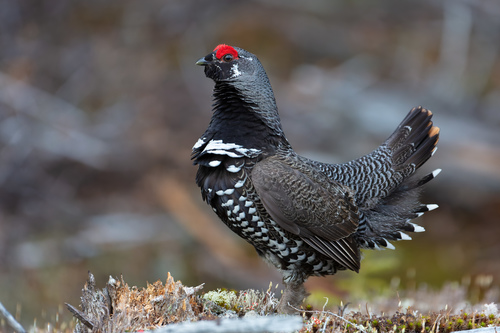
Spruce grouse (Canachites canadensis) measure 38–43 cm (15–17 in) in length. Males weigh 550–650 g (19–23 oz), while females weigh 450–550 g (16–19 oz), and the species has a wingspan of 55–57 cm (21.5–22.6 in). Geographic races differ slightly in plumage, particularly in tail pattern and the amount of white on the underparts. In general, adult males are mostly grey on their upper body and black on their underbody, with white spots along the sides, and a red patch of bare skin above the eye called an "eyebrow comb". This red eyebrow comb is not to be confused with the similar yellow marking found on other grouse species, including sharp-tailed grouse and dusky grouse. Adult females are either mottled brown (red morph) or mottled grey (grey morph), with dark and white bars on the underparts. Juveniles look similar to females. Females may be mistaken for ruffed grouse, but spruce grouse females have a dark tail with a pale band at the tip, the opposite of ruffed grouse tail pattern, and they do not erect their crown feathers when alarmed as ruffed grouse do. Spruce grouse are among the quietest of all grouse, but they still use a number of calls for purposes including warning of predators, repelling territorial intruders, keeping broods together, and eliciting brooding. In the subspecies franklinii, territorial males are known for their wing-clap display. At the end of a short flight through trees, the male brings his wings together over his back to produce two sharp claps roughly half a second apart; the claps are loud enough to be heard by the human ear 150 m (490 ft) away. These territorial displays can sometimes be triggered by similar hand clapping, and this can be used to find male territories and estimate their population density. Other non-vocal sounds include soft drumming from territorial males, produced by beating their wings, and a tail-swish and whoosh created by the tail feathers during flight. As a taiga specialist, spruce grouse are found across all of Canada. In the United States, they occur in Alaska, northern New England, the Adirondacks in New York, northern Michigan, northeastern Minnesota, northern Wisconsin, and the montane coniferous forests of Montana, Idaho, Maine, Oregon, and Washington. Spruce grouse are always associated with conifer-dominated forests, including pine, spruce, or fir stands. They tend to prefer young successional forest stands. In summer, they can be found near areas with a dense understory of blueberries and other shrubs, while in winter they prefer denser stands. Spruce grouse are mostly permanent residents. However, in southwestern Alberta, up to 35% of females and 7% of males move several kilometers (as far as 11 km / 6.8 mi) between summer breeding sites and wintering sites. Similar movements have also been recorded in Alaska and New Brunswick, Canada. This species prefers to walk on the ground or along tree limbs instead of flying. Like other grouse, they grow short lateral toe extensions called pectinations, or "snow shoes", in the fall. These extensions increase the surface area of the toes, helping support the bird on snow and likely improving grip on branches as well. The pectinations are shed in the spring. Flights are usually short, most often taking the bird from the ground to a nearby tree, or from a tree to the ground. Flight can be rapid, but no formal measurements of flight speed have been recorded. The main winter food source for spruce grouse is conifer needles, clipped directly from the tree. They prefer needles from the midcrown of pines, though they also feed on other conifers such as spruce. Spruce needles are high in calcium, and their increased use by female spruce grouse in spring may be related to egg production. In summer, the birds forage on the ground, eating berries, green plants like blueberry leaves, fungi, and some insects. In winter, when spruce grouse eat only conifer needles, the caeca (dead-end extensions of the intestines) and ventriculus (gizzard) increase in size to support digestion. Their crop is also well developed: up to 45 cc of needles (roughly 10% of body mass) can be stored in the crop at the end of the day, to be digested during the overnight fast. Like other birds, spruce grouse consume clay, grit, or small stones to help their gizzard break down food. Chicks less than 1 week old feed on insects and other arthropods, then shift to berries and fungi until fall, when they begin feeding on needles. Spruce grouse captured while on their winter diet have been kept successfully for several months without weight loss, fed only pine needles plus the grit and clay taken from the locations where the birds were observed consuming these materials.