About Campylorhamphus trochilirostris (Lichtenstein, 1820)
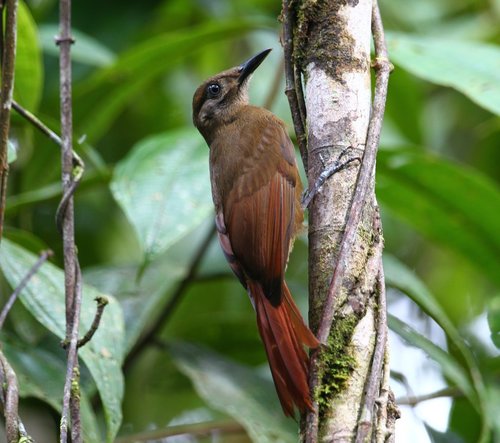
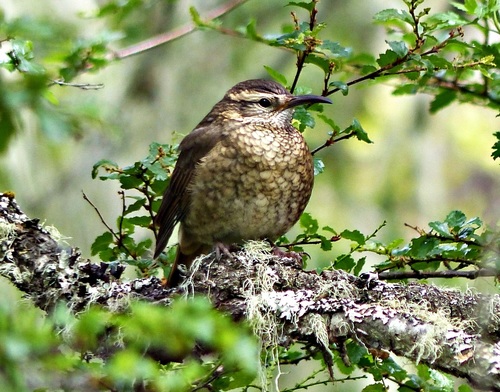
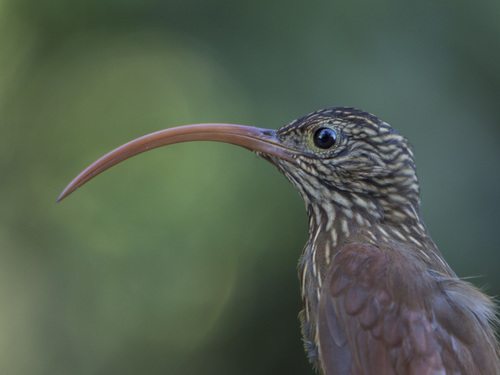
The red-billed scythebill (scientific name Campylorhamphus trochilirostris (Lichtenstein, 1820)) measures 22 to 28 cm (8.7 to 11 in) in length and weighs 30 to 55 g (1.1 to 1.9 oz). It is a slim, medium-sized woodcreeper with a very long, slender, dramatically decurved bill, and males and females have identical plumage. Adults of the nominate subspecies C. t. trochilirostris have thinly streaked faces and necks with a weak supercilium. Their crown, nape, and back are reddish olive-brown, with the back being somewhat lighter. The crown has longish whitish to ochraceous spots with narrow blackish edges; these spots narrow on the nape and become thin streaks on the upper back. Their rump is cinnamon-rufous that contrasts very little with the back, their flight feathers are rufous-chestnut, and their tail is a slightly darker rufous-chestnut. Their wing coverts have wide reddish olive-brown edges, and the tips of the primaries are dusky. Their throat and chin are white, and the chin has thin brownish streaks. Their underparts are a slightly lighter brown than the back, with buff streaks on the breast that narrow on the belly but do not extend onto the undertail coverts. Their underwing coverts are light cinnamon to ochraceous. Their iris is dark brown to hazel, their bill is bright red or reddish brown (often with a dusky tip and base), and their legs and feet are grayish olive to dull pea-green. Juveniles are less richly colored than adults, with less well-defined, more ochraceous streaks, and a darker, much shorter bill. Other subspecies differ from the nominate and each other in the following ways: C. t. lafresnayanus is larger with a longer bill than the nominate, has bright tawny-ochraceous underparts, and a brighter rufous back. C. t. hellmayri is larger than lafresnayanus with a longer, more robust bill. C. t. major is similar to lafresnayanus but overall paler, with less rufous upperparts and more rufous wings and tail, and a bill matching the nominate's. C. t. devius is similar to lafresnayanus but darker with a shorter bill, and has a strong buff wash on the throat. C. t. snethlageae is similar to devius but has darker underparts with a rufescent tinge, narrower crown streaks, and a whiter throat. C. t. notabilis is similar to snethlageae but overall paler brown with wider, whiter streaks. C. t. thoracicus has a bill matching the nominate's and a blacker crown. C. t. napensis is similar to thoracicus with a more decurved bill, a browner crown, and thinner black borders on its streaks. C. t. venezuelensis has a longer bill than the nominate, is darker overall, has a buffier, more heavily streaked throat and a blackish crown, darker olive-brown body, and deeper rufous-chestnut rump, wings, and tail. C. t. brevipennis is like venezuelensis but slightly smaller with a longer bill. C. t. zarumillanus is like venezuelensis but larger with a longer, less curved bill. Each subspecies has a distinct geographic range: C. t. brevipennis is found from central Panama's Coclé Province into Colombia along the Pacific coast to northern Chocó Department. C. t. venezuelensis occurs locally across northern Colombia from Córdoba Department into northern and central Venezuela to the Rio Orinoco. C. t. thoracicus is found along the coast from Colombia's Nariño Department south into western Ecuador. C. t. zarumillanus occurs along the coast in far northwestern Peru's departments of Tumbes and Piura. C. t. napensis is found in the Amazon Basin of eastern Ecuador and eastern Peru. C. t. notabilis occurs in southwestern and western Brazil south of the Amazon River between Acre state and the Rio Madeira. C. t. snethlageae is found in the Amazon Basin of central Brazil, on both sides of the Amazon and its islands between the Rio Madeira and Rio Tapajós. C. t. major occurs in interior eastern and southern Brazil from Piauí and Ceará south to extreme western Paraná. C. t. trochilirostris is found along coastal eastern Brazil between Pernambuco and Bahia. C. t. devius occurs in the southwestern Amazon Basin in northern Bolivia, and possibly extends into immediately adjoining southeastern Peru and western Brazil. C. t. lafresnayanus is found in eastern Bolivia, Mato Grosso and Mato Grosso do Sul in Brazil, and western Paraguay. C. t. hellmayri occurs in southwestern Paraguay's Ñeembucú Department and northern Argentina as far south as Entre Ríos Province. The red-billed scythebill inhabits a wide variety of wooded landscapes, most of which are open to semi-open. These include Gran Chaco woodland, gallery forest, cerrado, caatinga, forest clusters in savannah, secondary forest, and some scrublands. In the Amazon Basin it favors seasonally flooded várzea and igapó forest and riverside canebrakes. In terms of elevation, it mostly occurs below about 1,200 m (3,900 ft), but it reaches 1,900 m (6,200 ft) in Ecuador and 2,100 m (6,900 ft) in Venezuela.