About Campylorhamphus pusillus (P.L.Sclater, 1860)
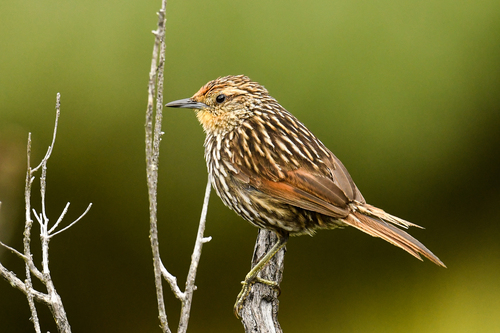
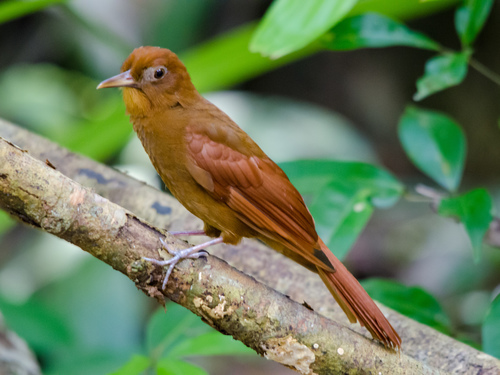
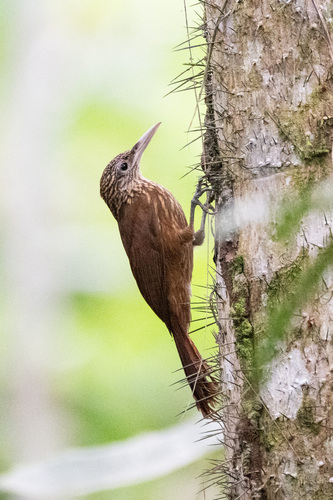
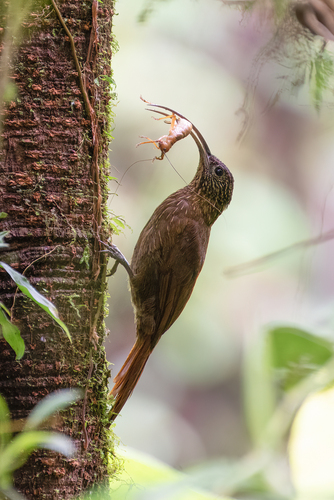
The brown-billed scythebill (Campylorhamphus pusillus) is 20 to 25 cm (7.9 to 9.8 in) long and weighs 32 to 48 g (1.1 to 1.7 oz). It is a slim, medium-sized woodcreeper with a very long, slim, distinctly decurved bill. The sexes have identical plumage. Adults of the nominate subspecies have faces and necks streaked with buff and blackish brown, plus a faint buffy supercilium. Their crown and nape are dark brown, marked with thin deep buff streaks that extend sparsely onto the upper back. Their back and wing coverts are deep reddish brown, their rump is cinnamon-rufous, and their wings and tail are rufous-chestnut. Their primaries have grayish brown edges and dusky tips. Their throat is deep buff with dusky streaks. Their underparts are dark brown to olive-brown, becoming more rufescent on the lower belly and undertail coverts. Their lower neck, breast, and upper belly have thin deep buff streaks, while their undertail coverts have lighter buff streaks. Their underwing coverts are cinnamon-buff to ochraceous. Their iris is dark brown to cinnamon-brown, their bill is blackish brown to brownish horn, and their legs and feet are olive-green to blackish brown. Juveniles are darker and more olivaceous than adults, with wider deeper buff but less distinct streaks, and a shorter and darker bill. Other subspecies differ from the nominate and each other as follows: C. p. borealis is darker overall than the nominate, has a more blackish crown, more olive underparts, narrower but more extensive and deeper buff streaks above and below, deeper chestnut wings and tail, and a darker maxilla. C. p. olivaceus is smaller and darker than borealis, with a black crown, deeper brown back, and more olive underparts. C. p. tachirensis is more olive than the nominate, especially on the underparts. C. p. guapiensis is smaller than the nominate, more brownish, and has ochraceous streaking only on the crown, nape, breast, and upper belly. Subspecies of the brown-billed scythebill have discontinuous ranges, distributed as follows: C. p. borealis is found on the Caribbean slope and part of the Pacific slope of Costa Rica, western Panama into Chiriquí and Bocas del Toro provinces, with one recorded sighting in extreme southern Nicaragua. C. p. olivaceus occurs in central and eastern Panama between Veraguas and Darién provinces. C. p. tachirensis is found in the Serranía del Perijá of northeastern Colombia, and the extreme Eastern Andes extending into the northwestern Venezuelan states of Zulia and Táchira. C. p. guapiensis lives in coastal areas of southwestern Colombia's Cauca Department. C. p. pusillus is found on both slopes of Colombia's Western and Central Andes, extending south through both slopes of Ecuador's Andes, and into the Andes of Peru on the east slope as far as the Department of San Martín. The brown-billed scythebill inhabits humid evergreen forest, mostly in highlands but also locally in lowlands. It favors middle-elevation cloudforest, where it occurs in the forest interior and at edges. It is less often found in mature secondary forest. In Central America, it mostly occurs at elevations between 300 and 1,700 m (1,000 and 5,600 ft), but reaches 2,500 m (8,200 ft) in southern Costa Rica. In Colombia, its elevation ranges from 250 to 2,700 m (800 to 8,900 ft). In Ecuador, it mostly occurs between 600 and 2,100 m (2,000 and 6,900 ft), but is found locally as low as 300 m (1,000 ft).