About Campylorhamphus falcularius (Vieillot, 1822)
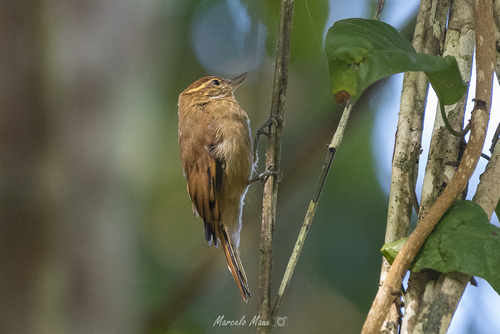
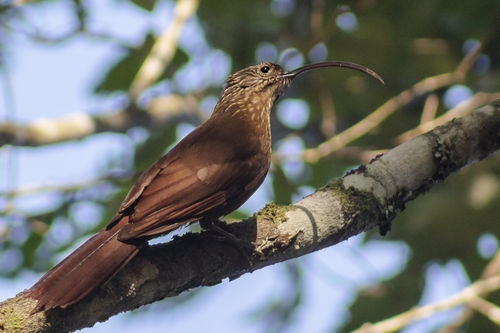
The black-billed scythebill (scientific name: Campylorhamphus falcularius (Vieillot, 1822)) measures 24 to 28 cm (9.4 to 11 in) in length and weighs 37 to 42 g (1.3 to 1.5 oz). It is a slim, medium-sized woodcreeper with a very long, slender, strongly decurved bill. Males and females have identical plumage. Adult individuals have a face thinly streaked with buff and blackish tones, marked by a narrow buffy-white supercilium. Their neck has streaks of the same colors, but the streaks are coarser. Their crown and nape are blackish, with thin whitish to ochre streaks that extend onto the upper back. Their back, wing coverts, and rump are brownish to olive-brown. Their wings, uppertail coverts, and tail are rufous-chestnut; the primary feather tips are blackish brown, and the tail feathers have blackish shafts. Their throat is whitish with dark olive-brown streaks. Their underparts are pale brown to olive-brown, shifting to more cinnamon color on the undertail coverts. Their breast has faint, thin whitish to creamy buff streaks that vanish on the belly and reappear faintly on the undertail coverts. Their underwing coverts are rosy cinnamon. Adults have a dark cinnamon-brown iris, a brownish black to black bill, and legs and feet that are yellowish green, greenish gray, or dark gray. The Brazilian population of this species is generally more rufescent and has a slightly browner crown than populations further south. Juveniles have brown legs and a shorter bill than adults. The black-billed scythebill is distributed from Chapada Diamantina in Bahia, southeastern Brazil, south into northern Rio Grande do Sul; it also occurs in the Alto Paraná and Itapúa departments of eastern Paraguay, and in the Misiones and Corrientes provinces of northeastern Argentina. It primarily lives in humid and semi-deciduous Atlantic Forest, and its range also extends into drier caatinga and cerrado where forest grows into these habitats. It prefers mature evergreen forest, cloudforest, mature secondary forest, and thickets of Guadua bamboo. In the southern part of its range, it occurs from near sea level up to at least 1,600 m (5,200 ft) in elevation, while in the northern part it is seldom found below 600 m (2,000 ft).