About Campuloclinium macrocephalum (Less.) DC.
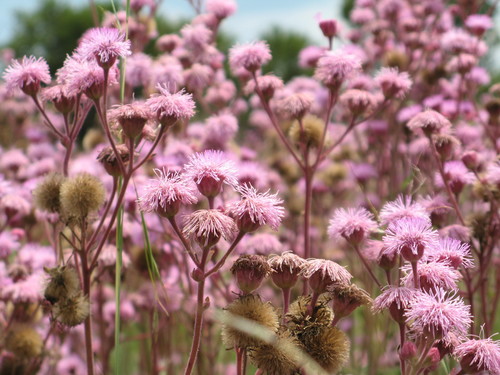
Campuloclinium macrocephalum (Less.) DC., also known by the synonym Eupatorium macrocephalum Less. and common name pompom weed, is a cosmopolitan perennial plant in the Asteraceae family. It is considered an invasive weed in some countries. This species is native to the southern United States, Central America, and South America, and it has been introduced to South Africa. It is classified as a principal weed in Brazil. In South Africa, it was originally cultivated as an ornamental plant. It is often found growing along roadsides, and it has been a concerning invader of undisturbed climax grassland and wetlands there since the 1960s. It is closely related to Siam weed, and is one of around 268 species in its genus. Campuloclinium macrocephalum is rhizomatous, with erect stems that can reach 1.3 meters tall. Its stems and leaves are covered in rough, bristly hairs. It forms dense ground-level leaf rosettes that suppress the germination and growth of other plant species, while also producing allelochemicals that negatively impact the growth of neighboring plants. Each year, the above-ground portions of the plant die back to its root crown, allowing it to survive winter veldfires. Its leaves are light green, lanceolate-elliptic in shape, and measure 8 cm by 2 cm. Leaf margins are serrate, with teeth that become smaller farther from the stem. Flower heads are surrounded by 8 mm-long lanceolate, purplish bracts. The flowers are large, pink, and showy, extending 6–8 mm beyond the surrounding bracts. Mature achenes are black, 5 mm long, and bear a pappus made of simple bristles. Moths in the genus Adaina, particularly Adaina microdactyla (Hübner), have been studied as potential biological control agents for this invasive weed. Genus Adaina moths include flower borers, leaf feeders, and species that form stem galls that provide food and shelter for moth larvae and pupae. Research conducted at Cedara College of Agriculture identified the rust fungus Puccinia eupatorii, which invades the plant's seeds and kills the entire individual, including its roots. This rust fungus is specific to Campuloclinium macrocephalum, making it an ideal candidate for biological control. Other potential insect control agents include a stem-galling thrips of the genus Liothrips, and the moth species Cochylis campuloclinium. Chemical analysis of material from this species has identified six triterpenes, one diterpene glycoside ester, six steroids, a flavonoid called cirsilol, and six cinnamic acid derivatives. The name Eupatorium macrocephalum was first published in January 1830 by Christian Friedrich Lessing in Linnaea 5(1): 136–137. The genus name Eupatorium was first used by Linnaeus to honor Eupator Dionysius, also known as Mithridates, an ancient ruler of Anatolia. The specific epithet macrocephalum means 'large-headed', and refers to the species' inflorescence.