About Camptostoma obsoletum (Temminck, 1824)
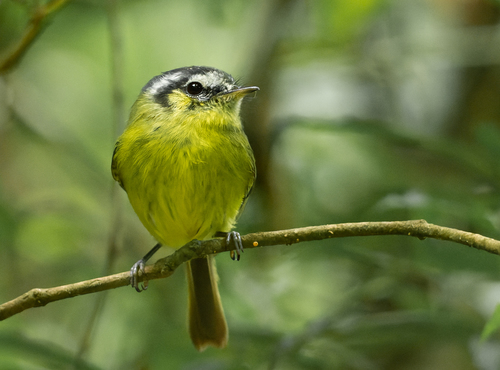
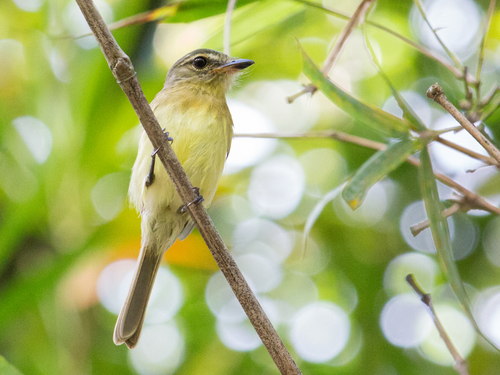
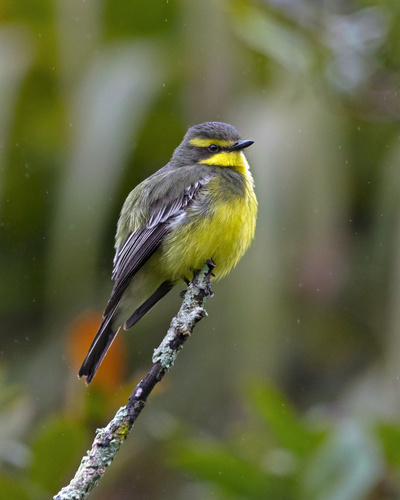
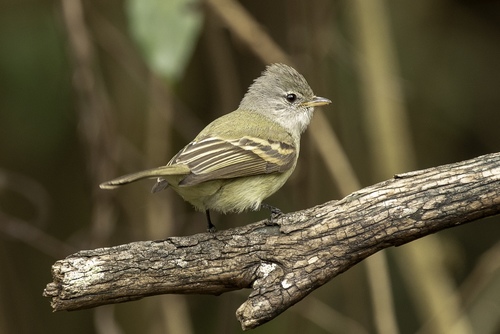
The southern beardless tyrannulet (Camptostoma obsoletum) is 9.5 to 10.5 cm (3.7 to 4.1 in) long and weighs 7 to 9 g (0.25 to 0.32 oz). It is a small flycatcher with a long, pointed, warbler-like bill. Males and females have identical plumage. Adults of the nominate subspecies, C. o. obsoletum, have a grayish crown and nape; their crown feathers are often bushy with dark centers. They have white lores and a broken white eyering on an otherwise grayish white face. Their upperparts and tail are medium olive-gray. Their wings are dusky, with whitish to creamy edges on the inner flight feathers. Their wing coverts have cinnamon tips that form two wide bars on the closed wing. Their throat is grayish white, and most of their remaining underparts are pale yellow with a faint olive wash on the breast. Juveniles are duller and browner than adults, with pale buffish white underparts. For both sexes of all subspecies, the iris is brown, the maxilla is horn-colored, the mandible is dull orangish or pinkish, and the legs and feet are gray. The other subspecies of southern beardless tyrannulet differ from the nominate subspecies and from each other as follows: C. o. flaviventre has warm grayish olive upperparts with a somewhat darker crown, creamy white wing bars and inner flight feather edges, and deep yellow underparts. C. o. orphnum is the smallest subspecies, with a very dark crown. C. o. majus is similar to flaviventre but grayer overall, with less contrast between its crown and the rest of its plumage. C. o. caucae has drab grayish olive upperparts with a darker crown, creamy white to pure white wing bars, and very pale yellow underparts with a distinct grayish to grayish olive cast on the breast. C. o. pusillum looks like caucae but is slightly smaller. C. o. napaeum is similar to caucae and pusillum but has slightly darker olive plumage. C. o. maranonicum is smaller and much paler than the nominate, with slightly olive gray-brown upperparts, a cinnamon-buff tinge to its wing bars and inner flight feather edges, and creamy white underparts with a warm gray cast on the breast. C. o. olivaceum has a dark olive crown, olive upperparts, pale yellow-green to whitish wing bars, bright yellow-green edges to inner flight feathers, and bright yellow underparts. C. o. sclateri is smaller and paler than the nominate, though somewhat darker than maranonicum, and has dull cinnamon uppertail coverts. C. o. griseum is smaller and paler than the nominate, though somewhat darker than maranonicum. C. o. bolivianum is slightly larger than the nominate. C. o. cinerascens looks like the nominate but has slightly paler underparts.
The subspecies of the southern beardless tyrannulet are distributed as follows: C. o. flaviventre occurs on the Pacific slope of Costa Rica and on both slopes of Panama. C. o. orphnum occurs on Coiba Island off southwestern Panama. C. o. majus occurs on the Pearl Islands off southern Panama. C. o. caucae occurs in Colombia, on the western slope of the Western Andes, in the Cauca River and upper Magdalena River valleys, and on the eastern slope of the Eastern Andes. C. o. pusillum occurs on Trinidad, along the Caribbean coast and in the lower Magdalena valley of Colombia, and in northern Venezuela from the east to Sucre state and south to Apure and northern Amazonas states. C. o. napaeum ranges from Amazonas and southeastern Bolívar states in Venezuela, east across the Guianas and northern Brazil to the Atlantic coast in Amapá and Pará states. C. o. maranonicum occurs in Peru, in eastern Piura Department and the middle valley of the Marañón River in Amazonas, Cajamarca, and Ancash departments. C. o. olivaceum ranges from southeastern Colombia south through eastern Ecuador into eastern Peru, reaching central Ucayali, and extends east into western Amazonas state of Brazil south of the Amazon River. C. o. sclateri occurs in western Ecuador and extends south into Tumbes and northern Piura departments in far northwestern Peru. C. o. griseum occurs along the Pacific coast and slope of western Peru, between Lambayeque and Lima departments. C. o. bolivianum occurs on the eastern slope of the Andes from central Bolivia south into northwestern Argentina as far as Tucumán Province; it also migrates to southeastern Peru. C. o. cinerascens occurs in eastern Brazil in an area roughly bounded by Maranhão, Ceará, Espírito Santo, and central Mato Grosso states, and extends into Bolivia's eastern Santa Cruz Department. The nominate C. o. obsoletum ranges from southern Mato Grosso to Rio de Janeiro state in southern Brazil, south to Paraguay, Uruguay, and northeastern Argentina as far as La Pampa and northern Buenos Aires provinces.
The southern beardless tyrannulet occurs in almost every available habitat across its range. These habitats include desert with cactus, thorn-scrub, deciduous forest, gallery forest, humid forest edges, secondary forest, edges along watercourses and oxbow lakes, and parks and gardens in built-up areas. It generally avoids the interior of continuous humid forest, but occasionally occurs in várzea and swamp forests. In terms of elevation range, it reaches 1,200 m (3,900 ft) in Costa Rica, 750 m (2,500 ft) in Panama, 1,500 m (4,900 ft) in Colombia, 2,800 m (9,200 ft) in western Ecuador and is mostly found below 300 m (1,000 ft) in eastern Ecuador, 2,600 m (8,500 ft) in Peru, 1,000 m (3,300 ft) in Venezuela, and 2,000 m (6,600 ft) in Brazil.