About Camponotus socius Roger, 1863
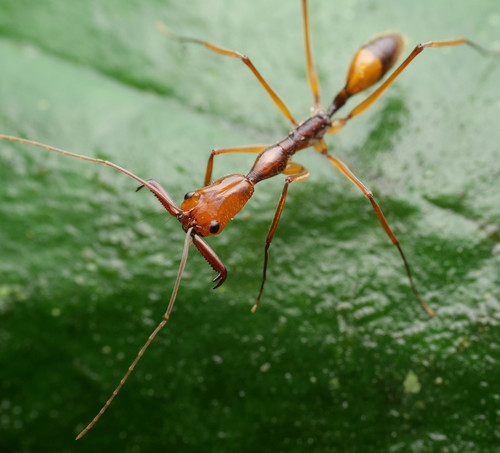
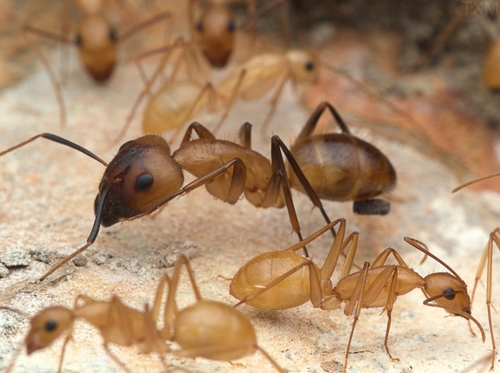
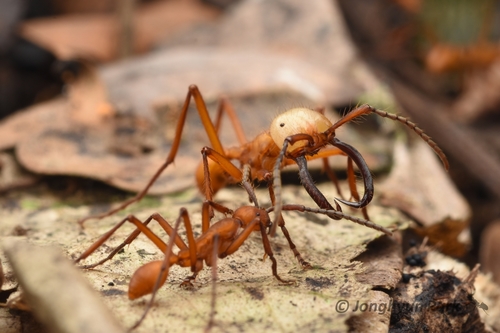
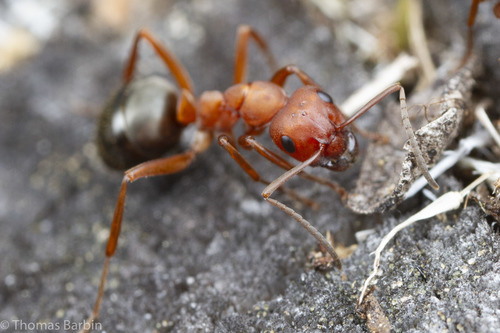
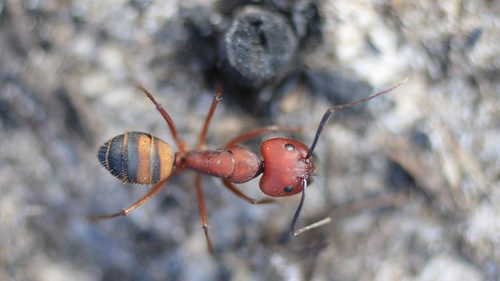
Camponotus socius Roger, 1863 has a variegated gaster that somewhat resembles a wasp’s gaster. Each of its tergites has deep bronze to apricot orange bands, which vary in their extent and intensity based on local population and environment. Its thorax and legs are typically rusty brownish burgundy or vermilion, and its head is most often a darker brown maroon. This is a polymorphic species; minor workers have elongated heads and spindly body proportions, a characteristic of carpenter ants in the subgenus Tanaemyrmex. The antenna scape has no hair. This is one of the largest North American carpenter ant species. Minor workers range from 7.5 to 10 mm in length, while major workers reach an average length of 16 mm. Large queens typically measure 17 to 18 mm long, and may reach 20 mm when physogastric. Males are uniformly black, and measure around 14 mm long. Reproductive brood overwinters and develops to maturity the following year. Winged alates finish their development by midsummer, and take nuptial flights between August and early November. Alates can be seen moving along the perimeter of their nests on warm, windless, overcast days after heavy rains, between 2 and 5 p.m. If favorable conditions last up to or through 4 p.m., alates will begin to swarm out of their natal nest. Females walk a considerable distance away before taking flight, while males usually take off directly from the nest. Fully claustral queens dig their founding chambers the following morning, then remain dormant there for half a month to three months before raising the first generation of workers. Each individual colony only rears a few hundred alates per season. The first nuptial flights of a season are typically the largest, while later flights are smaller.