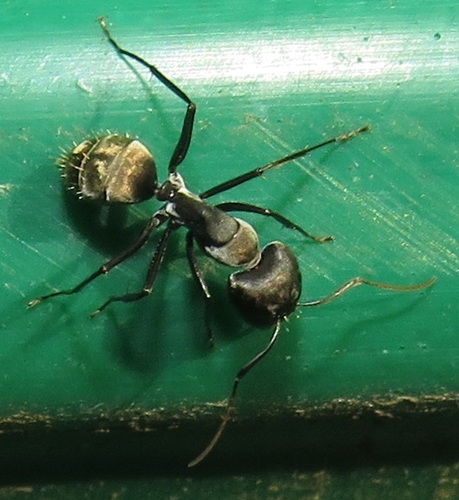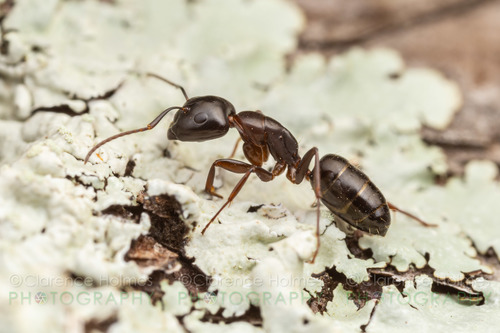
About Camponotus nearcticus Emery, 1893
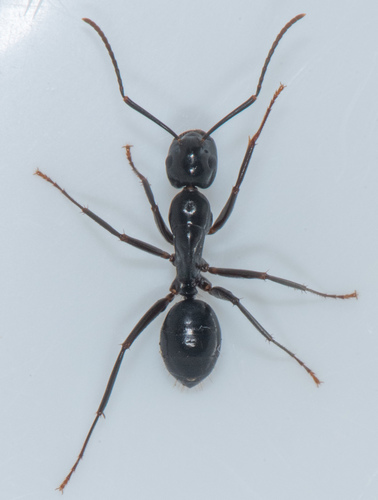
Identification: Worker ants of this species range from 3.5 to 7.5 mm (0.14 to 0.30 in) in length, while queen ants range from 4 to 10 mm (0.16 to 0.39 in). This species can be distinguished from other members of its subgenus by three features: it has few erect hairs on the gena, limited erect hairs on the clypeal disc, and a concolorous dark brown-black body color. Distribution and habitat: Colonies of Camponotus nearcticus are found in Canada and the United States. In Canada, they occur in Ontario; in the United States, their range extends south from North Dakota to Colorado and Florida. This species prefers prairies and woodlands, including deciduous forests, oak stands, and pine forests. Colonies nest in dead twigs, branches, logs, tree bark in various conditions, and pine cones. They also nest in wooden structures of buildings, most commonly around rooftops. Nests are small, typically holding only a few hundred individuals. One documented large nest contained 531 individuals, not counting the nest's brood. Reproductives are usually found in nests from March to October. This ant is classified as a household pest.