About Camponotus herculeanus (Linnaeus, 1758)
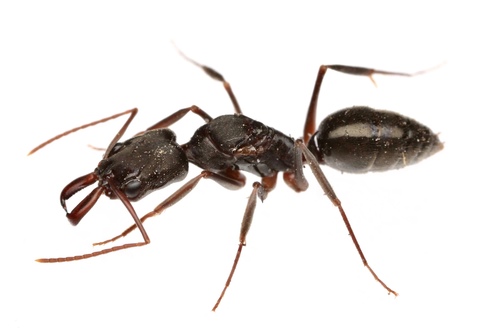
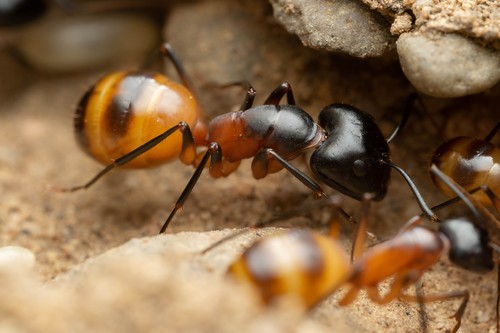
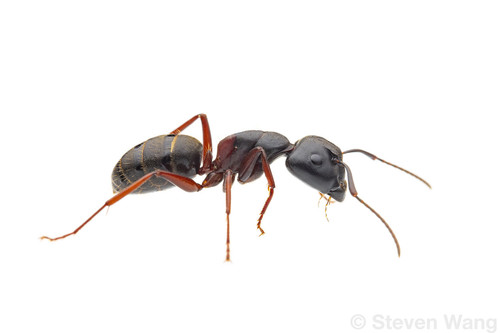
The colony of Camponotus herculeanus is made up of one or more wingless queen females, some fertile males, and three size-ordered sterile worker castes: majors (largest), intermediates, and minors (smallest). Queens are large, around 15 mm (0.6 in) long, and blackish. Males are also blackish but only about half the size of queens. Workers typically have blackish heads and gasters, with dark reddish-brown mesosomas, petioles, and legs. For scapes (the long antenna segments before the antenna elbow), scapes are shorter than the head length in major workers, around the same length as the head in intermediate workers, and extend well past the back of the head in minor workers. The head and dorsal surfaces of the mesosoma and gaster of the largest major workers are covered in bristles.
Camponotus herculeanus has a broad distribution across the Northern Hemisphere, and is found across most of Europe, Central and Northern Asia, Canada, and the United States. It is common in mountainous regions, and is the dominant ant species in mountainous and northern areas of North America. It lives in a variety of habitats, including different types of conifer and hardwood forests, clearings, oak scrubland, disturbed areas, pastures, and seashore grassland.
Nests of this ant species are constructed in timber, including living or rotting trees, stumps, and fallen logs, and occasionally in the structural timbers of buildings. The ants use their strong jaws to dig galleries and chambers under bark or inside wood, and prefer damp wood or timber affected by fungal decay. In standing trees, their tunnels can sometimes reach 10 m (30 ft) above ground level. Satellite colonies connected to the original main nest via underground tunnels may form nearby, often in warmer, drier sites. These satellite colonies hold older larvae, pupae, winged reproductive ants, and workers, while eggs and younger larvae stay in the main nest. A colony can contain multiple unrelated wingless females. Winged reproductive ants develop in late summer, overwinter inside the colony, and emerge to swarm and mate on warm spring days. Workers become active in spring and forage near the nest. They tend aphids, as well as larvae of the silvery blue butterfly Glaucopsyche lygdamus, which commonly feed on the lupine Lupinus bakeri. The ants' diet includes honeydew produced by sap-sucking insects, and they also eat any insect larvae they find. The ant cricket Myrmecophilus pergandei sometimes lives inside these ant colonies, and the ants tolerate its presence.