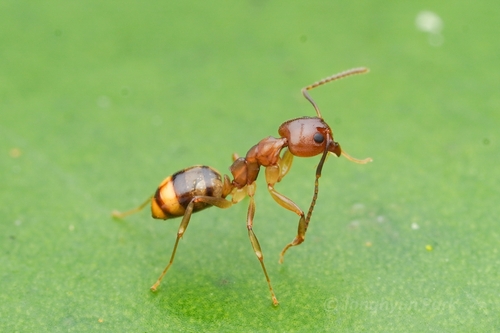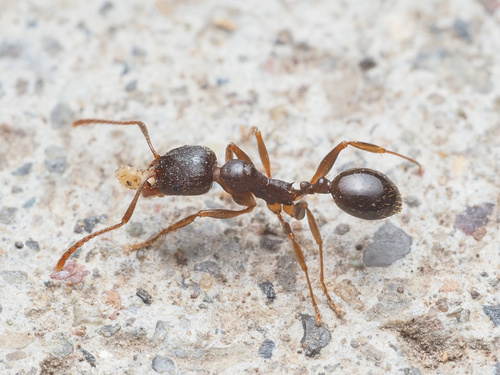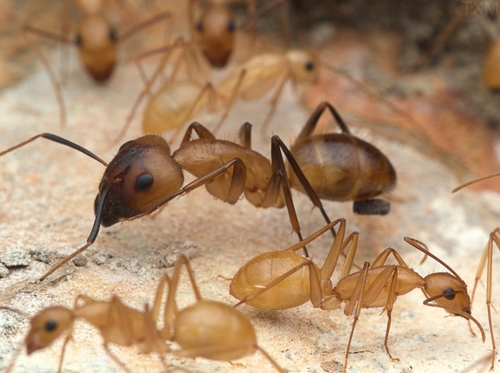
About Camponotus festinatus (Buckley, 1866)
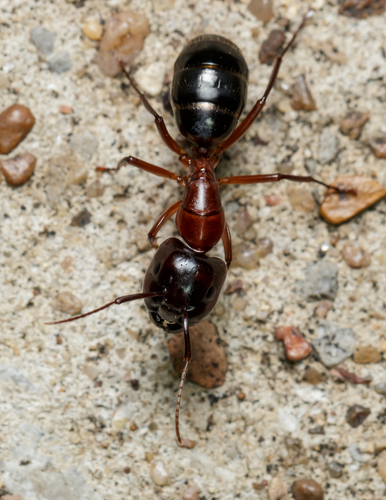
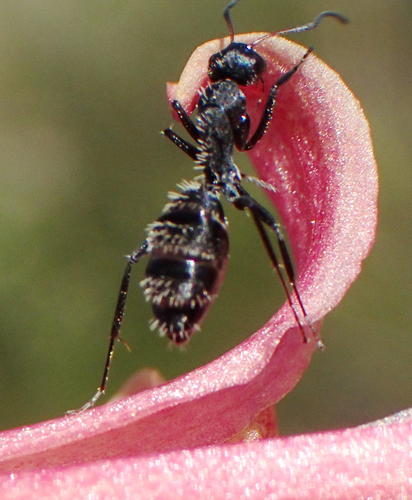
Camponotus festinatus (Buckley, 1866) is a species of carpenter ant. It is typically found in the Southwestern United States and the northern parts of Mexico, and is most common around Tucson, Arizona. This ant lives in the semi-dead branches of local palo verde trees. Camponotus festinatus feeds exclusively on liquid food; it can only consume tree sap or the fluids from dead animals. Like most ants, its diet is mostly made up of sugar, with a small amount of protein. Camponotus festinatus is not known to be aggressive, except when interacting with other ants. Soldiers of this species will usually flee from humans rather than act aggressively. While these ants are technically capable of biting with their mandibles, as formicine carpenter ants, they do not have a functional sting. Instead of stinging, they can use an acidopore to spray formic acid. Queens of C. festinatus are claustral foundresses: they seal themselves inside a chamber to start a new colony and raise their first generation of worker ants, without seeking or collecting additional food during this process. Per a 2006 publication by Snelling, C. festinatus was a difficult-to-categorize species complex that displayed a confusing variety of variant forms across its large native range. The publication identified two potential new undescribed subspecies of C. festinatus, split two entirely new species—Camponotus absquatulator and Camponotus microps—off from the original complex, and revived the species status of Camponotus pudorosus and Camponotus fragilis after they had been listed as synonyms.