About Camponotus detritus Emery, 1886
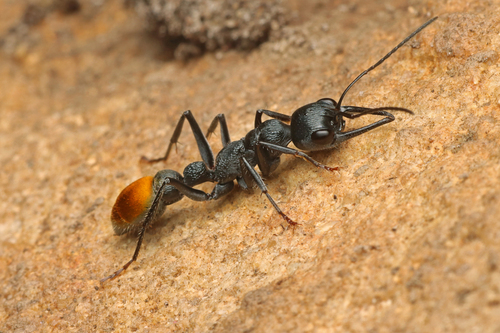
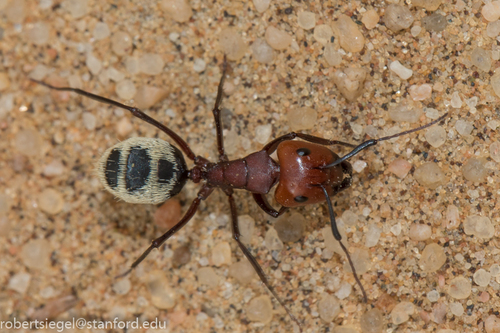
The Namib Desert dune ant, with the scientific name Camponotus detritus Emery, 1886, is a large ant species. It is distinguished by white and black symmetrical stripes and markings on its hairy abdomen, and has an average mass of 45 milligrams (0.0016 oz). This species is classified in the carpenter ant genus Camponotus, a large group of more than 1,000 known species. Many species in this genus are associated with forested habitats in America and other regions, but C. detritus inhabits the hot dry dunes of the hyper-arid central Namib Desert in Southern Africa. The distribution, abundance, and survival of the Namib Desert dune ant depend entirely on environmental temperature, humidity, and vegetation conditions, and these factors are critical to the survival of its colonies. Namib desert dune ants modify and build their habitats by collecting and using organic plant materials such as leaves. Their collection and use of these plant materials supports the nutrient recycling process of the desert ecosystem.