About Camponotus consobrinus (Erichson, 1842)
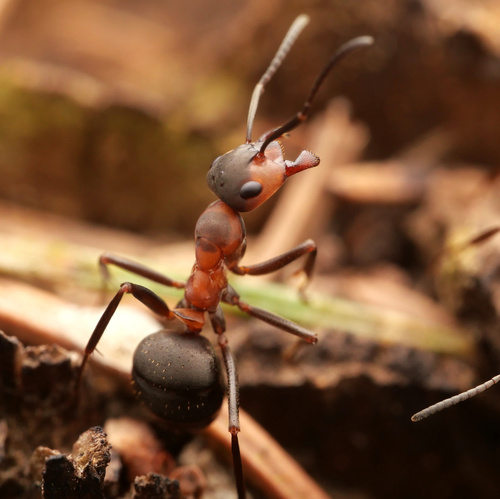
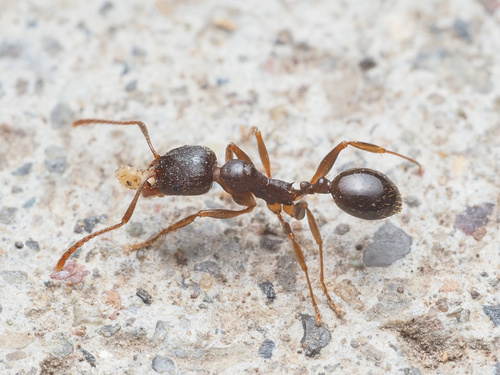
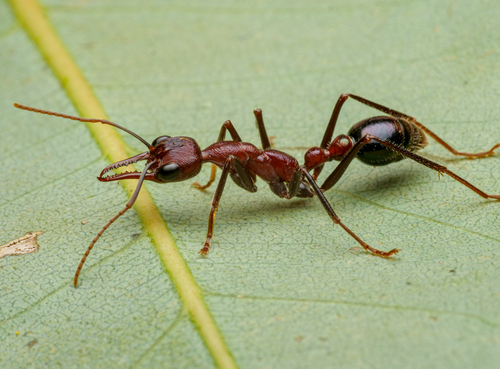
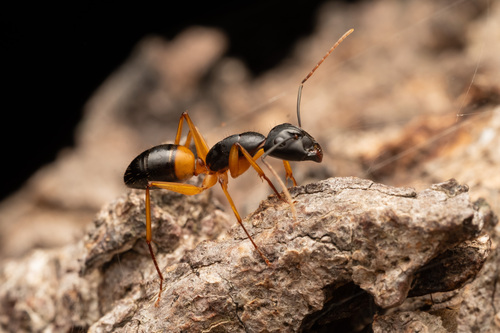
Camponotus consobrinus, commonly called banded sugar ants, is a large ant species that varies in body length from 4 to 16 millimetres (0.2 to 0.6 in). This species is polymorphic; colonies contain two castes of workers: minor workers and major workers (soldiers). Minor workers are smaller and more slender, while major workers are larger and more robust. Both castes have powerful mandibles, and queens are the largest individuals in the colony. Banded sugar ants show wide variation in body colour, which may be shaped by ecological factors rather than genetic factors: humidity, insolation, and temperature can all affect an individual’s colour. Females are easily recognizable by a black head, orange thorax, and an orange-brown band wrapping around the gaster. Males of the species are entirely black. The dark sides of the thorax and legs are ferruginous, or rust-coloured. The scape (the base of the antenna) and mandibles are black, and the head is wider than the thorax. The thorax is longer than its total width and slightly compressed, and the gaster is covered in tiny black dots. Erect setae are golden in colour; they are absent under the head but present on the mesosoma. Setae on the tibia and scape are shorter than setae on the mesosoma. The anterior section of the gaster is lighter in colour than the posterior section, and the dorsum of the mesosoma is outlined and curved. Workers lack a metanotum and have bulging eyes, while soldiers have a noticeable metanotum and flat eyes. Queen’s wings are dark, and their stigmata and nerves are yellow. Unlike many ant species, banded sugar ants do not have a metapleural gland. Workers have 21 malpighian tubules. The closely related black-headed sugar ant (Camponotus nigriceps) has a similar appearance and is often mistaken for the banded sugar ant; black-headed sugar ants are lighter in colour and lack the orange-brown gaster band. The banded sugar ant is one of the most widely distributed ant species in Australia, and it is most common in south-eastern Australia. It occurs along the north-east coast of Queensland, from Charters Towers in the north to Brisbane in the south. It is widespread across New South Wales, the Australian Capital Territory, Victoria and Tasmania. In South Australia, it is a common household pest in Adelaide; most of the state’s populations are found in the south-east, and the species is absent from the north-west. The species’ presence in Western Australia has not yet been verified. These ants inhabit urban areas, eucalypt forests, dry sclerophyll woodland, grasslands and heaths, and they prefer mesic habitats. They are absent from Australia’s drier regions, where they are typically replaced by Camponotus nigriceps. Recorded elevations for the species range from 170 to 853 metres (558 to 2,800 ft). Nests can be built in a variety of sites, including wood holes, plant roots, tree and shrub twigs, between rocks, in soil, and under paving stones. Sometimes colonies form small ephemeral, funnel-shaped mounds less than 20 cm (7.9 in) in diameter. Mounds are not built in undisturbed areas that have not experienced land degradation. In undisturbed areas, the nest entrance is a smooth-walled vertical shaft 15 to 17 millimetres (0.59 to 0.67 in) in diameter. Nest chambers have shaft-like walls similar to the entrance; chamber floors are typically 20 to 30 millimetres (0.8 to 1.2 in) in length, with an arched roof 10 millimetres (0.4 in) high. Banded sugar ants also inhabit abandoned excavated meat ant nests. Banded sugar ants are the dominant nocturnal ant group across their range. Workers are most often seen foraging at dusk along marked trails or on Casuarina and Eucalyptus trees. They do forage during the day, but they are seen far more often at night. They are also more active during warmer seasons, particularly summer. Banded sugar ants use several social methods to lead other ants to food sources: a worker may carry another worker, engage in tandem running, or leave a pheromone trail leading to the source. Between 2 and 35% of foraging workers take part in tandem running. Banded sugar ants often randomly attack the nests of other ant species, while ignoring other nearby ants. They use mandibles to hold opponents and formic acid to kill them. Foraging workers use visual cues to navigate, and to recognize when they are lost; they orient themselves by identifying familiar landmarks. When provoked, an individual will lift its abdomen and use its large mandibles to fend off attackers. If provoked further, it can spray formic acid from its abdomen to deter predators. Meat ants are a common competitor; they have been observed blocking banded sugar ant nesting holes with pebbles and soil to prevent the ants from leaving their nest in the early morning. Banded sugar ants counter this behaviour, called nest-plugging, by blocking meat ant nesting holes with debris to prevent meat ants from leaving. If a meat ant nest is overshadowed by trees or other shade, the meat ant colony’s health declines, and banded sugar ants may invade and take over the nest. Affected meat ant colonies move to a nearby suitable satellite nest, and invading banded sugar ants fill the nest galleries with a black resinous material. In a 1999 study, Pogonoscopus myrmex leafhoppers were placed in a banded sugar ant colony to test the non-host ants’ reaction. The leafhoppers were attacked, indicating no symbiotic relationship exists between the two species. Starlings have been observed rubbing banded sugar ants on their feathers and skin, a behaviour known as anting. Like all ants, banded sugar ants begin life as eggs. Fertilized eggs develop into females, while unfertilized eggs develop into males. They grow through complete metamorphosis, passing through larval and pupal stages before emerging as adults. Most banded sugar ant colonies are monogynous, meaning they have only one queen, but some colonies are polygynous, with multiple queens. This is the fourth Camponotus species recorded to exhibit polygyny. In polygynous colonies, queens are not territorial and offspring can move freely between queens. Even under shared homogeneous environmental conditions, different family lineages strongly correlate with different ant castes, indicating caste is largely genetically determined. Single-queen colonies are monandrous: a queen will mate only once with a single male. Little is known about nuptial flights, but alates (virgin queens and males) have been observed mating in South Australia in January, and in early December in south-east Queensland in 2017. This suggests nuptial flight occurs during mid-summer, when new colonies are founded. Nuptial flight happens on warm afternoons, with ideal temperatures between 20–25 °C (68–77 °F), when alates begin to swarm. Colonies can be very long-lived; queens live seven years or longer. The black carpenter ant (Camponotus pennsylvanicus) is known to adopt larvae and pupae from banded sugar ant colonies. Workers from different matrilines (different female ancestry) differ significantly in body size. Matrilines are also thought to influence caste determination in this species.