About Campanula rotundifolia L.
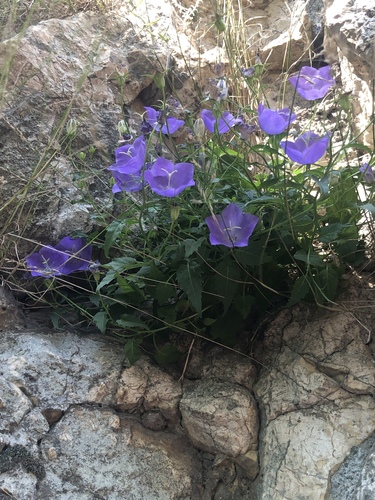
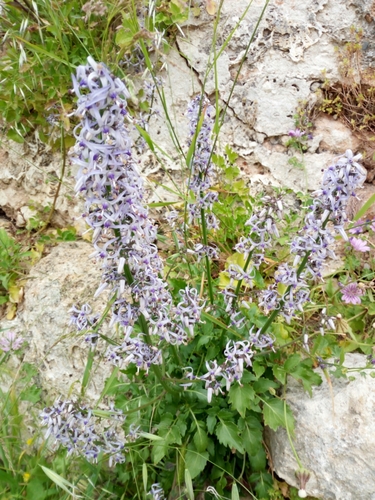
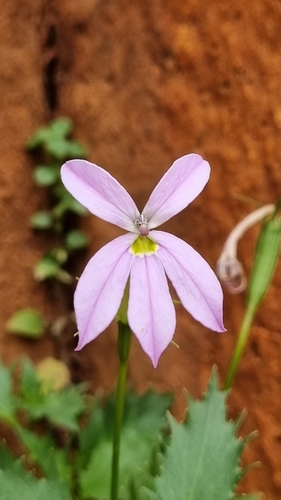
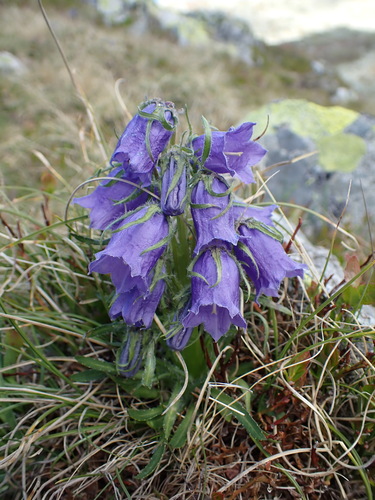
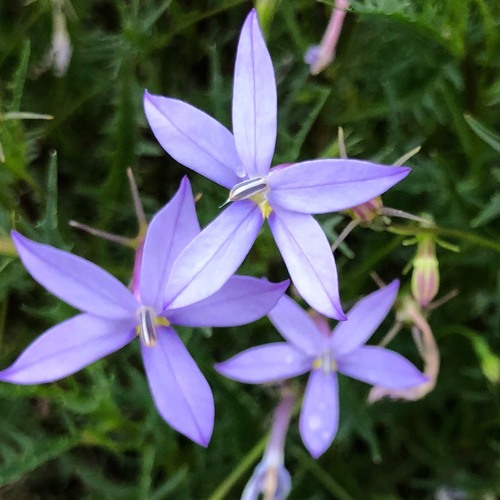
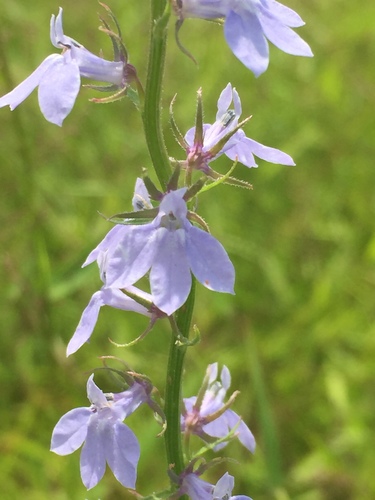
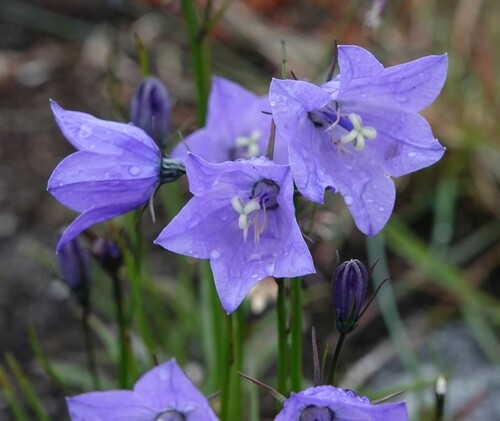
Campanula rotundifolia L. is a slender herbaceous perennial that grows prostrate to erect, spreading via both seeds and rhizomes. Its basal leaves have long stalks, are shaped rounded to heart-shaped, and are usually slightly toothed with prominent hydathodes; these leaves often wither early. Leaves growing on the flowering stems are long and narrow, and the upper stem leaves lack stalks. The inflorescence is a panicle or raceme, which holds 1 to many flowers attached to very slender pedicels. Flowers most commonly have five (occasionally 4, 6, or 7) pale to mid violet-blue petals fused together into a bell shape, around 12–30 mm (15⁄32–1+3⁄16 in) long. Five long, pointed green sepals sit behind the petals. Pale pink or white-flowered individuals can also occur. The petal lobes are triangular and curve outwards. Seeds develop inside a capsule around 3–4 mm (1⁄8–5⁄32 in) in diameter, and are released through pores at the base of the capsule. Seedlings are very small, but established plants are able to compete with tall grass. Like many other Campanula species, all parts of this plant exude white latex when damaged or broken. Its flowering period is long and varies by location: in the British Isles, it flowers from July to November. Its flowers are pollinated by bees, but are also capable of self-pollination. According to the POWO database, Campanula rotundifolia ranges from Iceland south through Great Britain and Ireland to Spain, and extends east across Europe and Asia to the Pacific coast of Russia and northeastern China, and is absent from North America. Some other European authors accept that it also occurs in Spitzbergen and on the southern coasts of Greenland. Some sources and authorities such as VASCAN and PLANTS do not currently separate distinct species within the North American populations. When using these sources, the species is considered widely distributed throughout North America, including all of Canada and most of the United States. In Britain and Ireland, populations of Campanula rotundifolia are tetraploid or hexaploid, while diploid populations are widespread across continental Europe. In Britain, the tetraploid population is distributed in the east, the hexaploid population is distributed in the west, and very little mixing occurs at the boundaries of their ranges. Harebells grow in dry, nutrient-poor grasslands and heaths. The species often successfully colonizes cracks in walls or cliff faces, as well as stable dunes. It tends to grow in climates with an average temperature below 0 °C in the coldest months and above 10 °C during the summer. Research on Campanula rotundifolia in Iceland has found that it acts as a host for at least three species of pathogenic fungi: Coleosporium tussilaginis, Puccinia campanulae, and Sporonema campanulae (with the teleomorph Leptotrochila radians).