About Campanula rapunculus L.
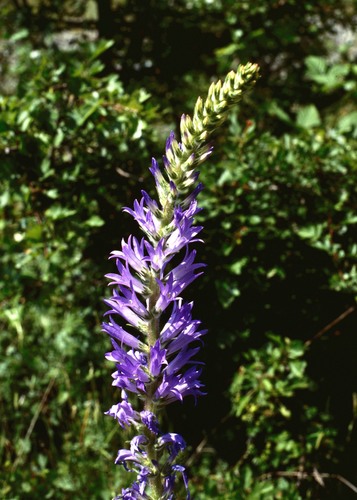
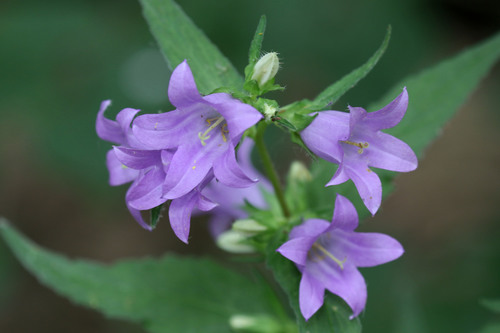
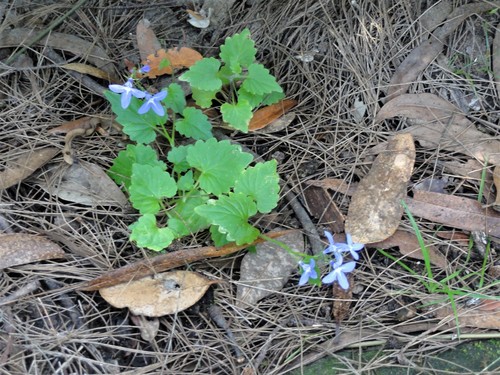
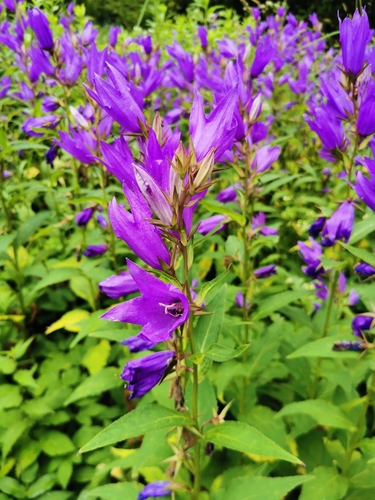
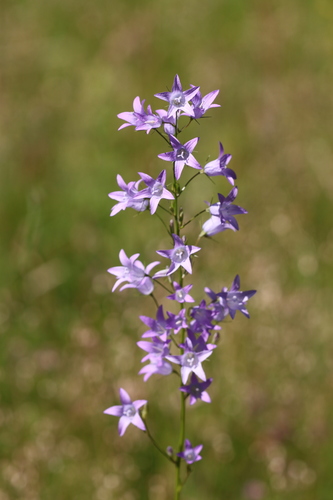
This is a description of Campanula rapunculus L., commonly known as rampion. It is a biennial herbaceous plant that reaches an average height of 40–80 centimetres (16–31 in), with a maximum height of 100 centimetres (39 in). Its stem is erect, lightly hairy, and branched at the top. Basal leaves are petiolated, ovate, slightly toothed, and arranged in a rosette, while upper leaves are sessile and narrow lanceolate. Its hermaphrodite flowers form a racemose inflorescence; each flower has a bell-shaped, light blue or violet corolla about two centimeters long. The flowers are arranged along the stem in a fairly narrow, one-sided cluster. Its flowering period runs from May through September. The fruit is an inverted cone-shaped dehiscent capsule that holds many seeds. It has a thick, small turnip-like root that is edible. The chromosome number of this species is 2n = 20. Wild bee species from the genus Chelostoma rely on Campanula rapunculus as a pollen source. Campanula rapunculus is native to western Asia, northern Africa, and most of Europe, excluding Iceland, Ireland and Norway. It has been introduced to Denmark, southern Sweden, and Great Britain. This species was once widely cultivated across Europe for its leaves, which were eaten like spinach, and its parsnip-like root, which was used like a radish. Campanula rapunculus is winter-hardy. It grows on poor soils, and prefers limestone soils. It can be found in dry meadows, cultivated beds, oak and pine forests, and along roadsides and lanes, growing at altitudes between 0–1,500 metres (0–4,921 ft) above sea level. Rampion can be cultivated as an agricultural crop. Sowing takes place at the beginning of June. Loose soil is favorable for growth, and fertilization is not required. It grows best in well drained, rich sandy-loam soils that are neutral or alkaline, with a pH range of 4.8 to 7.5. Its seeds are very small, with a thousand grain weight of just 0.04g. To achieve more uniform seedling distribution, 20 parts sand are mixed with one part seed before sowing. Recommended row distance for planting is 20–25 cm. Seeds are not covered with soil after sowing, only lightly pressed onto the soil surface. Plants must be thinned after germination. Roots can be harvested from October through the rest of the winter. On soils rich in carbon, phosphorus, and nitrogen, the species can produce up to 135g of dry matter per square meter. On more sandy soils or sub-soils, dry matter production only reaches 12 to 17g per square meter. Rampion is grown after nutrient-demanding crops such as cabbage, tomatoes, potatoes, or cucumbers. It can also be grown as a catch crop between lettuce crops.