About Campanula rapunculoides L.
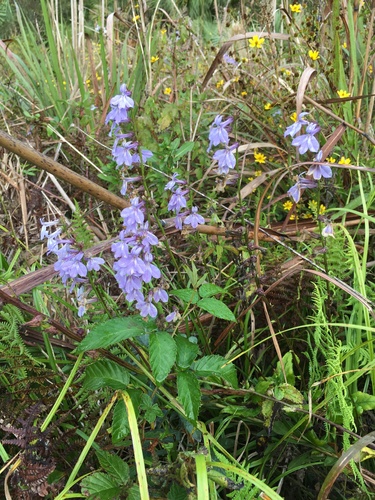
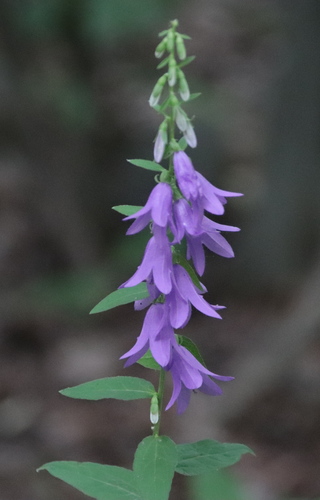
Campanula rapunculoides L. has an average height of 30–80 centimetres (12–31 in), and can reach a maximum height of 120 centimetres (47 in). Its stem is simple, erect, and lightly pubescent, and its leaves are usually shortly hairy. Basal leaves are triangular and narrow, with heart-shaped or rounded bases and jagged edges, growing up to 12 centimetres (4.7 in) long. Upper stem leaves are sessile, lanceolate, and have short stalks. The inflorescence is made up of nodding, spike-like racemes that hold numerous drooping flowers. Flowers are bright blue-violet, rarely white, 2 to 4 centimetres (0.79 to 1.57 in) long, with short petioles that grow to one side in the axils of the bracts. Bracts are quite distinct from leaves and smaller than the plant's leaves. Sepals are lanceolate to ovate-lanceolate, smooth-edged, and wide at the base, reaching up to 2.5 millimetres (0.098 in) across. The corolla is bell-shaped with five deep, slightly ciliate lobes. The flowering period runs from June through September. Flowers are pollinated by insects including bees, flies, and butterflies, a process called entomophily. The fruit is a capsule with five pores near its base, from which seeds are released. This plant produces a large number of seeds: each individual plant can produce up to 15,000 seeds. When pulled, only some of its roots are removed; the plant grows horizontal rhizomes that develop vertical storage tubers, which may not be located near the above-ground portions of the plant. These storage tubers can regrow new rhizomes, which produce new shoots some distance from the original tuber. Campanula rapunculoides is a hemicryptophyte, meaning its overwintering buds are located just below the soil surface. It spreads via underground rhizomes and produces deep, taproot-shaped tubers; both rhizomes and tubers are white and fleshy. Because any fragment of its roots can sprout and grow into a new plant, this species is extremely hard to eradicate. This species is native to Europe and western Siberia, where it grows in semi-shaded areas including open woods, the edges of denser forests, and meadowland. It has been introduced to North America, where it has become an extremely invasive weed that crowds out other plants; elimination is nearly impossible due to its multiple propagation methods. Like many related and more distantly related Campanula species, Campanula rapunculoides is edible, and was historically cultivated for food. Its roots, shoots, and leaves are all edible. The roots can be eaten raw or cooked. The above-ground parts are mild-flavoured, described as rather bland and commonplace, with somewhat chewy leaves. Basal leaves are often cooked as a pot herb, and blend in unnoticeably with other leafy greens. Campanula rapunculoides grows in grassy areas, dry hills, meadows, deciduous and pine forests, woods, fields, roadsides, along railway lines, and in hedgerows. It prefers partial shade, and grows in dry to moist sites on clay soils that are relatively rich in nitrogen, at altitudes ranging from 0 to 2,000 metres (0–6,562 ft) above sea level. It also grows as a weed in cultivated fields.