About Campanula petiolata A.DC.
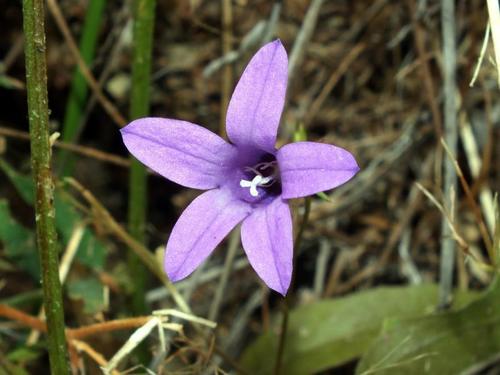
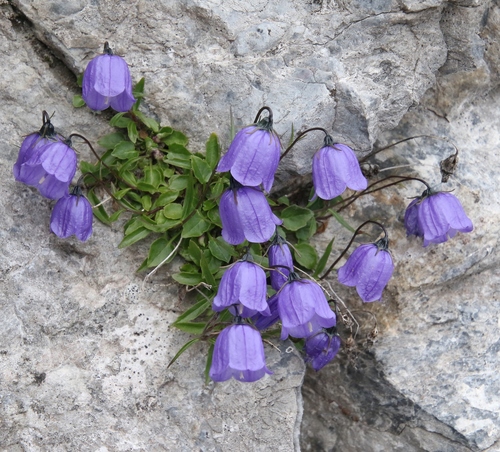
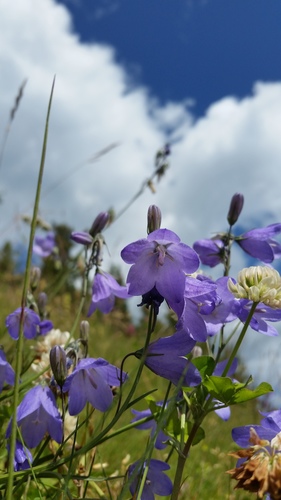
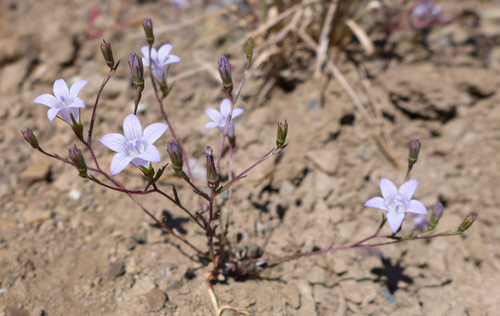
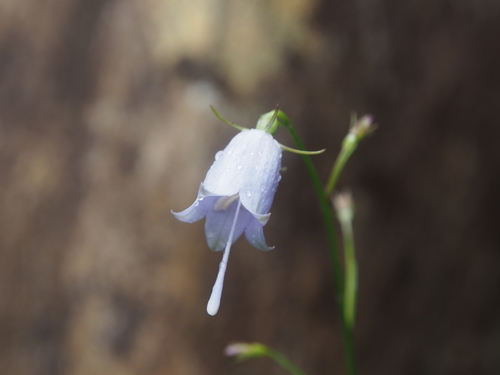
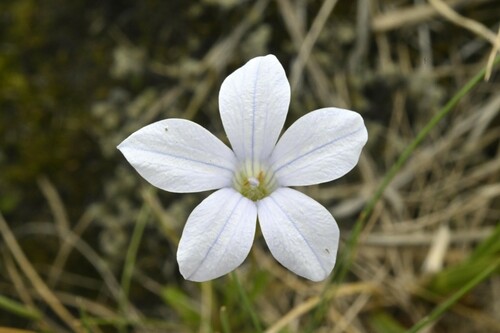
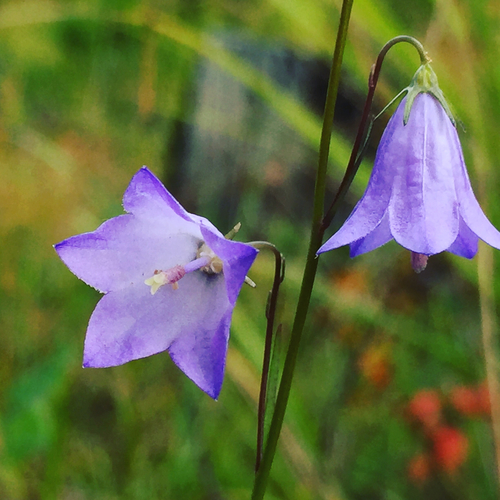
Campanula petiolata A.DC. is a slender, herbaceous perennial that grows prostrate to erect, reaching 10–50 centimeters tall when fully mature. The plant’s basal leaves are round to ovate (egg-shaped), mostly toothed, and typically disappear before flowering; basal leaves are more commonly ovate than round. Lower stem leaves are slightly widened at the middle, giving them a lanceolate (thin lance point) shape, with serrate (saw-toothed) edges. Upper leaves are reduced, and are either linear (long and thin like a grass blade) or slightly lanceolate. Because it grows in drier North American habitats, its foliage is firmer than that of Campanula rotundifolia. Leaf surfaces are usually smooth, and are only rarely slightly rough in texture with fine hairs (scabrous-pubescent). Flowering stems are usually smooth; when hairy, very small hairs cover the entire stem instead of being restricted to lines along the stem. Stems are also typically more strictly upright than stems of Campanula rotundifolia. Its inflorescence is a panicle or raceme, with 1 to many flowers growing on very slender pedicels. Flowers are bell-shaped with a 5-cleft calyx (five points formed from five fused sepals), and are sometimes broader than they are long. Flower color is usually pale lavender to dawn blue; pale white or albino flowers can also occur, with pale white flowers having a pink-lavender stigma and albino flowers having a creamy white stigma. After flowering finishes, the plant produces a nodding capsule that holds very minute seeds. It grows from short underground rhizomes. According to Plants of the World Online, Campanula petiolata grows from the far north of Canada (Nunavut and Yukon) southward to the United States west of North Dakota, South Dakota, Colorado, and Texas. Its southern range limit extends into northeastern Mexico. In the Pacific Northwest, it is unevenly distributed from sea level up to approximately 1900 meters in elevation. In the Southern Rocky Mountains, it is often found on grassy hillsides, in lodgepole pine forests, and along road cuts in montane ecosystems, ranging from the foothills to the timberline. In northern Mexico, it grows in three states: Chihuahua, Coahuila, and Nuevo León. Campanula petiolata grows in relatively dry mountain areas or in medium (mesic) soils. In moister conditions, it requires well-drained gravelly or sandy soils. The leaf-cutter bee species Megachile melanophaea has been collected from the flowers of Campanula petiolata at least once. It is one of the few plant species that continues blooming through mid-July to August in Colorado’s high mountain parks. Commonly called western harebell, this rhizomatous species forms clumps of plants, and tends to develop this clumping form more strongly when growing in sunny conditions.