About Campanula persicifolia L.
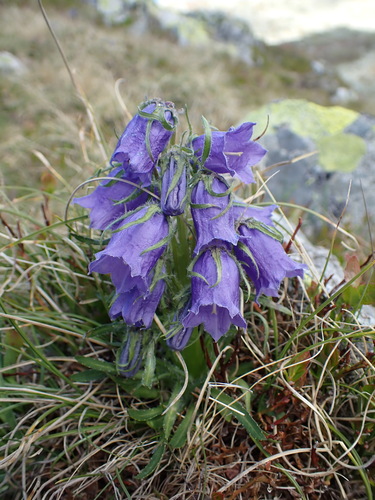
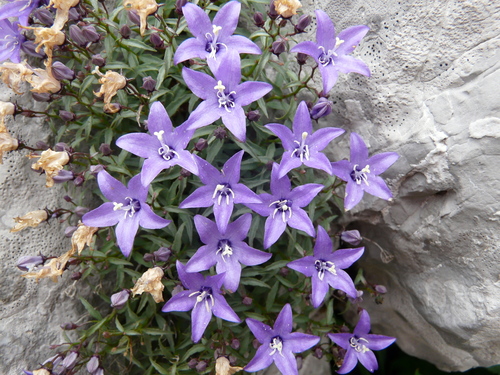
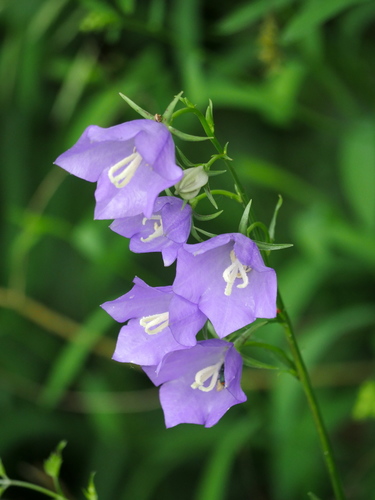
Campanula persicifolia L. is a clump-forming perennial herbaceous plant that reaches 30 to 100 centimetres (12 to 39 inches) in height. Its stem is typically unbranched, erect, and slightly angular. Basal leaves are short-stalked, narrowly spatulate, and usually wither before the plant begins flowering. Upper leaves are unstalked, lanceolate, almost linear, and have rounded teeth along their margins. The inflorescence forms as a few-flowered terminal raceme, or occasionally bears just a single flower. The calyx is fused with five narrow lobes that eventually spread outward. The corolla is five-lobed, 30 to 50 mm (1.2 to 2.0 in) long, and made of five fused violet-blue petals, which are occasionally white. The corolla lobes are shorter than they are wide. The plant has five stamens and a pistil formed from three fused carpels. Its fruit is a strongly veined, conical capsule. Flowering occurs from June to August. Campanula persicifolia is common in the Alps and other European mountain ranges. It grows at lower altitudes in northern parts of its range, and at higher altitudes further south, reaching over 1,500 m (4,921 ft) in Provence. It normally flowers in June, and a dry summer can reduce or stop its flowering. Even so, it can flower as late as September in a cold year. Its natural habitats are broad-leaved forests, woodland margins, rocky outcrops within broad-leaved woods, meadows, and banks. In cultivation, numerous varieties and cultivars have been developed in a range of colors including white, blue, pink, and purple.