About Campanula medium L.
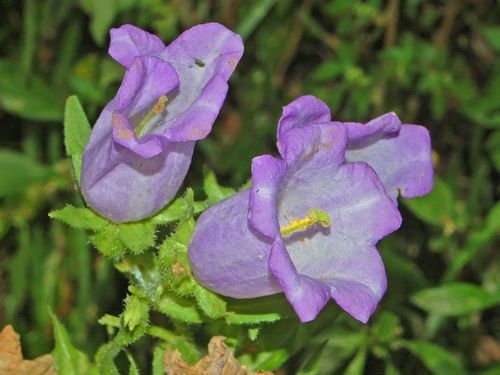
Campanula medium L., commonly known as Canterbury Bell, reaches approximately 60–80 cm (24–31 in) in height. It is a biennial herbaceous plant that forms leaf rosettes in its first year, then grows stems and flowers in its second year. Its stem is erect, robust, reddish-brown, and covered in bristly hairs. Basal leaves are stalked, range from lanceolate to elliptical in shape, measure 12–15 cm (5–6 in) long, and have serrated edges. Upper leaves are smaller, lanceolate, sessile, and almost wrap around the stem. The flowers are arranged in a racemose inflorescence, with extremely long-lasting blooms. These attractive bell-shaped flowers are short-stalked, large, and hermaphroditic, displaying various shades of violet-blue, or rarely white. The corolla has five fused petals with lightly bent lobes, a structure categorized as a coronate flower type. In the Northern Hemisphere, the flowering period runs from May to July. This species reproduces via either self-fertilization (autogamy) or insect pollination by bees and butterflies (entomogamy). Seeds ripen from August to September and are dispersed only by gravity, a process called barochory. Campanula medium is native to southern Europe. It is naturalized across most European countries, in North America, and is widely cultivated for its attractive flowers. Its natural habitat is stony, rocky, bushy slopes, growing at altitudes between 0 and 1,500 metres (0–4,921 ft) above sea level. Campanula medium works well as a cut flower for floral arrangements. Beekeepers sometimes use this species to produce strongly sweet honey.