About Campanula cervicaria L.
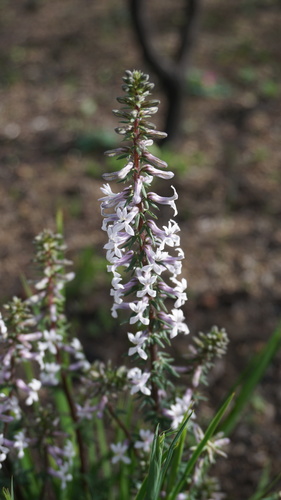
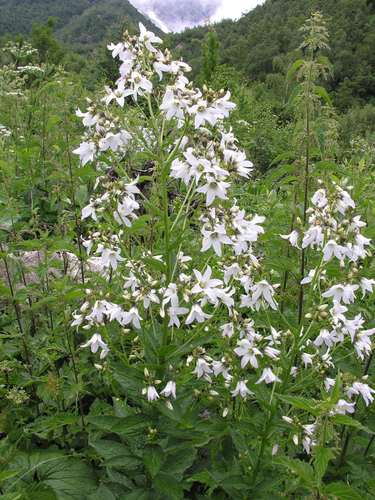
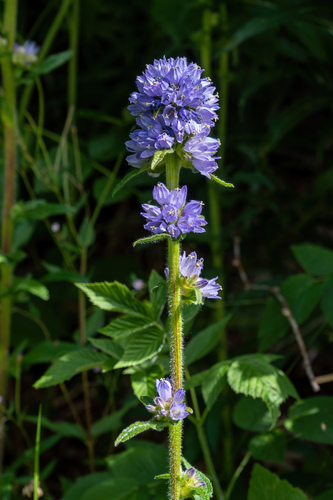
The bristly bellflower, scientifically named Campanula cervicaria L., is a biennial or short-lived perennial herbaceous plant that reaches 30 to 100 centimetres (12 to 39 inches) in height. In its first year of growth, it produces a rosette of lanceolate, spatulate leaves with winged stalks. In its second year, it grows one or more erect flowering stems with squarish edges. The leaves on these flowering stems are arranged alternately, shaped linear to narrow lanceolate, covered in bristles, and unstalked. The leaf blades are undulating, and their margins have rounded teeth. Lower leaves wither away while the plant is flowering. Its inflorescence forms a dense terminal cluster, with additional smaller clusters growing from upper leaf axils. Each flower has a fused calyx with five blunt lobes. The five-lobed corolla measures 12 to 20 mm (0.5 to 0.8 in) long, made of five fused pale blue petals, which are occasionally white. The corolla lobes are longer than they are wide. The flower contains five stamens and a pistil formed from three fused carpels. The fruit is a strongly veined, narrowly conical, nodding capsule, and flowering occurs from June to September. Bristly bellflower is native to Scandinavia and Central Europe. It has become naturalized in Lake and St. Louis counties of Minnesota, and is not naturalized in other parts of North America. Its natural habitats include woodland edges, hillside meadows, dry meadows, and banks. It also grows well in areas where soil has been disturbed, including after slash-and-burn, after forest clearance, or during active coppicing.