About Campaea perlata (Guenée)
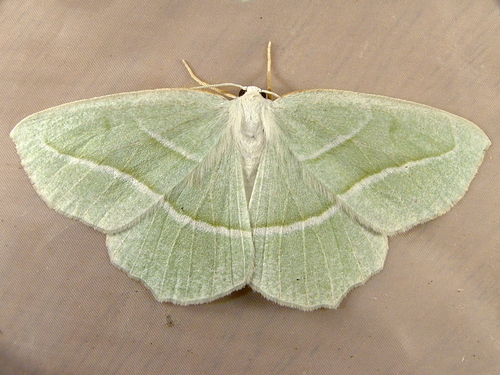
Campaea perlata (Guenée), commonly known as the pale beauty, is a medium-sized moth with an average wingspan of 28–51 mm. Females of this species are typically much larger than males. The moth’s body and wings range in color from pale greenish to white, with faint continuous antemedial and postmedial lines that stretch across both the forewings and hindwings. Pale beauty larvae are a type of "inchworm" or "looper" caterpillar. This group’s characteristic looping walking gait comes from only having movement appendages at the front and back of the body. Fully developed caterpillars reach about 4 cm in length. Their coloration is mottled gray to reddish on the upper body, pale on the underside, with a dark band running from the top of the head to the eye. They have a fringe-like row of setae along the lower sides of the body, and an extra set of prolegs on the fifth abdominal segment, which is the eighth overall body segment of the animal. Caterpillars strongly resemble twigs, and their fringe setae act as camouflage that eliminates cast shadows. The pale beauty moth occurs across most of North America, inhabiting deciduous forests, wooded areas, and parks. Its range extends across Canada to Newfoundland and Labrador, and reaches north to the Yukon. In the United States, it is found in Alaska, ranges south to Arizona, and has occasional reported sightings in Florida. Adult pale beauty moths fly from June to September, though flight timing can vary by region. The species usually has two generations per year: an overwintering generation and a summer generation. In the far northern parts of its range, it may only produce one generation per year. Overwintering caterpillars reach full maturity around May to June, while summer generation caterpillars mature between June and September. When a larva is fully grown, it pupates inside a light green cocoon. Pale beauty larvae are generalist feeders, and have been recorded feeding on 65 different species of trees and shrubs. Their larvae produce antifreeze proteins that create a significant depression of their freezing point, allowing them to survive low winter temperatures. They may overwinter on tree trunks or branches without seeking shelter from winter conditions, a behavior similar to that of its European close relative, Campaea margaritata. Research has found that the pale beauty moth has a genetically fixed background preference, and chooses to rest on light backgrounds to improve its camouflage. The confirmed larval food plants of the pale beauty are: alder, ash, basswood, beech, birch, blueberry, Canada buffaloberry, cherry, fir, elm, hemlock, maple, oak, photinia, pine, poplar, rose, spruce, tamarack, and willow.