About Camissoniopsis bistorta (Nutt. ex Torr. & A.Gray) W.L.Wagner & Hoch
Growth Form
Camissoniopsis bistorta is a herbaceous plant that grows as an annual or short-lived perennial. Young plants average approximately 2 to 3 cm (0.79 to 1.18 in) in size, and mature individuals reach a wide range of overall sizes.
Indumentum
The entire plant is covered in either strigose or spreading hairs.
Stem Characteristics
It occasionally grows with a single simple stem, but more often produces several stems. These slender stems are prostrate, decumbent, or relatively ascending, reaching 50 to 80 cm (20 to 31 in) in length, and the older epidermis of stems peels away.
Leaf Arrangement & Size
Leaves are alternately arranged and measure 1.2 to 12 cm (0.47 to 4.72 in) long. Some leaves have a constriction that forms a spatulate, less hairy tip.
Basal Leaves
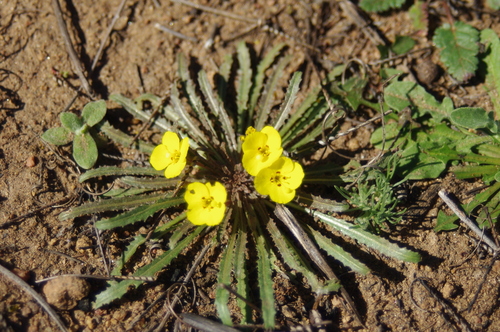
Basal leaves grow from a rosette on petioles up to 4 cm (1.6 in) long, and are narrowly elliptic in shape.
Cauline Leaves
Cauline leaves are usually subsessile or sessile, generally lanceolate in shape, with margins that range from minutely toothed to roughly entire.
Inflorescence
The inflorescence is a nodding spike when in bud, and covered in short, erect hairs.
Flowering Traits
Flowers of this species are self-incompatible, and open at dawn. The hypanthium is 2 to 6 mm (0.079 to 0.236 in) long.
Sepals & Petals
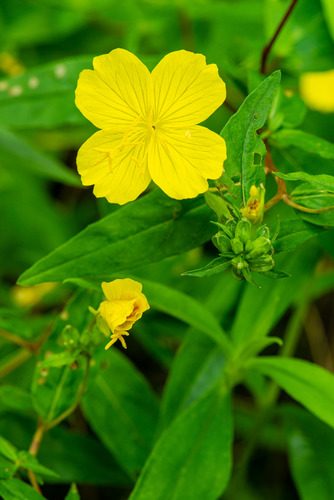
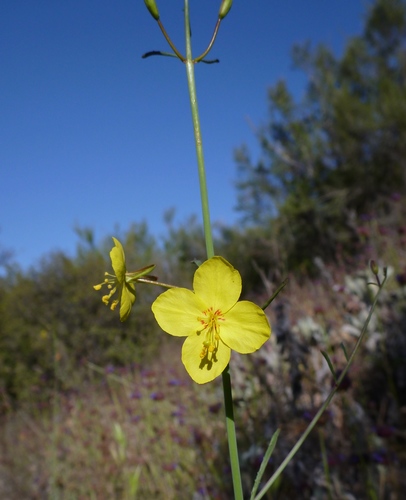
Flowers have 4 sepals that are 5 to 8 mm (0.20 to 0.31 in) long, and 4 petals that start yellow and fade to red. The petals measure 7 to 15 mm (0.28 to 0.59 in) long, with 1 to 2 red spots near their base.
Stamens & Stigma
There are 8 stamens, with anthers attached at their middle. At anthesis, the stigma extends past and sits well above the anthers.
Fruit Characteristics
Fruits are 12 to 40 mm (0.47 to 1.57 in) long and 1.5 to 2.5 mm (0.059 to 0.098 in) wide. They are roughly quadrangular, and generally straight, slightly wavy, or twisted.
Seed Size
Seeds measure 0.9 to 1 mm (0.035 to 0.039 in) across.
Native Range
This species is native to California, United States and Baja California, Mexico.
California Distribution
In California, it occurs in the southwestern part of the state, ranging from Kern and Ventura counties south to San Diego County, and inland to the Peninsular Ranges and Transverse Ranges.
Baja California Distribution
In Baja California, it ranges from the international border inland to Tecate, and south to the Colonet area.
Interspecific Hybrids
Hybrids between this species and Camissoniopsis cheiranthifolia occur on Pacific beaches between Tijuana and Ensenada.
Habitat
Camissoniopsis bistorta is commonly found growing in sandy fields near the coast, but also grows in clay soils in grasslands and in openings within coastal sage scrub and chaparral.
Associated Species
In some locations in San Diego County, it grows alongside young individuals of two rare deceptively similar plants: Chorizanthe orcuttiana and Mucronea californica.