About Camassia quamash (Pursh) Greene
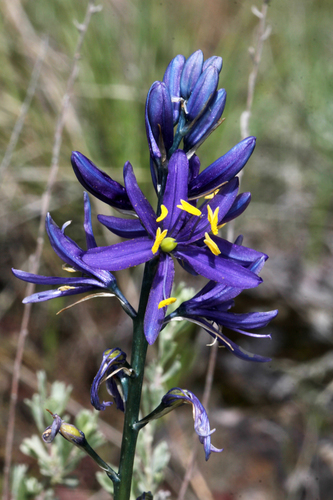
Camassia quamash (Pursh) Greene is a variable perennial herbaceous monocot, with grass-like leaves that grow from a persistent, moderately sized bulb. The bulb measures 1 to 5 centimeters (1⁄2 to 2 inches) in diameter, rarely clusters with other bulbs, has a black outer surface, and a white, layered interior similar to an onion. A single plant very rarely produces more than nine leaves, which range from 10 to 60 cm (4 to 24 in) long and 4 to 20 mm wide, growing all from the plant's base. The upper surface of the leaves may have a pale waxy coating or not, depending on the variety. The plant's sturdy stem is leafless; flowering stems can reach up to 80 centimeters (2.6 ft) tall, and may be as short as 20 cm (8 in) in both wild and cultivated specimens. The unbranched inflorescence is a raceme, bearing pale blue to deep blue flowers from late spring to early summer (May to June in the species' native habitat). Each radially symmetrical, star-shaped flower is around 2.5 cm (1 in) across, with six tepals and six stamens. This plant shares the same growing range as the toxic white-flowered meadow death-camas, a member of the genus Toxicoscordion not belonging to Camassia, and their leaves and bulbs are similar in appearance. Camassia quamash is native to western North America, across large areas of southern Canada and the northwestern United States, ranging from British Columbia and Alberta south to California, and east from Washington state to Montana and Wyoming. While the once-vast expanses of camas lands have shrunk due to modern development and agriculture, many camas prairies and marshes still exist today. In the Great Basin, increased white settlement, followed by allowing cattle and hogs to graze on camas prairies, greatly reduced the traditional food supply for Indigenous tribes and heightened tension between Native Americans and settlers and travelers. Both the Bannock and Nez Perce Wars began after the Nez Perce grew angry at the U.S. government's failure to uphold treaties, and at settlers who plowed up the camas prairies the Nez Perce depended on for subsistence. This bulb flowering plant naturalizes well in garden settings. Its bulbs grow best in well-drained soil with high humus content. It can grow in lightly shaded forest areas, on rocky outcrops, in open meadows or prairies, and alongside streams and rivers. Plants can be divided by hand in autumn after the leaves have withered. The species spreads by seed rather than by runners. In the Pacific Northwest, the Lekwungen people and other groups have cultivated kwetlal bulbs of this species since precolonial times, and kwetlal has been promoted as a good replacement for invasive species for both environmental and cultural restoration projects. Camassia quamash is grown as an ornamental plant; large wild populations can turn an entire meadow blue-violet. The bulbs of this species are edible and nutritious when roasted or boiled, but they are easily confused with the toxic bulbs of death-camas. While white death-camas have very different flowers, the bulbs of the two species are difficult to tell apart. Camas has been a traditional food source for many Indigenous peoples across western United States and Canada. Bulbs are harvested in autumn after the flowers withered, then pit-roasted or boiled; boiling produces a syrup. A pit-cooked camas bulb looks and tastes similar to baked sweet potato, but is sweeter, with more crystalline texture from inulin, an oligosaccharide that causes significant flatulence when undercooked bulbs are eaten in large amounts. Bulbs can also be dried and pounded into flour for baking or use as a thickener. Many Native American tribes have used camas as food, including the Nez Perce, Cree, Coast Salish, Lummi, and Blackfoot tribes, among others. Camas bulbs helped sustain members of the Lewis and Clark Expedition (1804–1806). Camas bulbs and bannock made from them are included in the Ark of Taste.