About Calytrix tetragona Labill.
Calytrix tetragona Labill., commonly known as common fringe-myrtle, is a shrub that typically grows to a maximum height of 3 m (9.8 ft). Its leaves can be linear, oblong, egg-shaped, lance-shaped, or narrowly elliptic, and measure 0.75–14 mm (0.030–0.551 in) long and 0.4–1.5 mm (0.016–0.059 in) wide. The base of each leaf tapers abruptly to a petiole 0.2–1.5 mm (0.0079–0.0591 in) long.
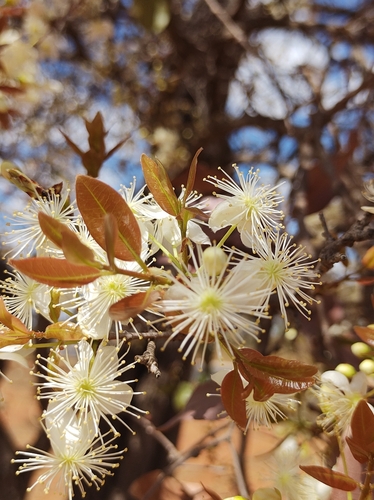
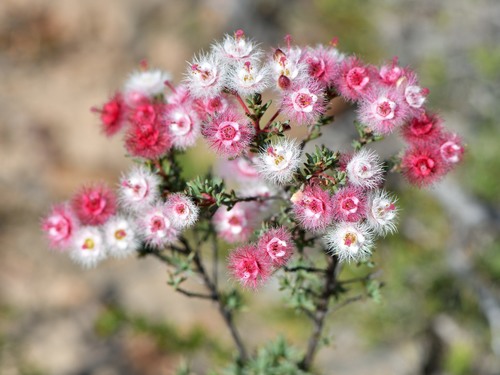
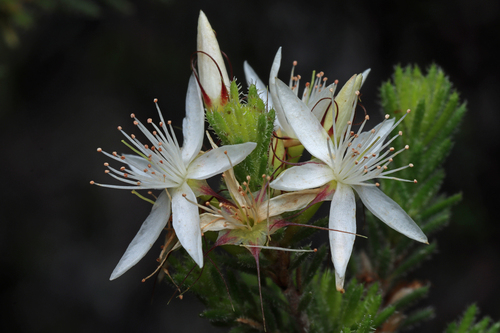
Flowers of this species are usually borne in dense clusters on a narrowly funnel-shaped peduncle 1.0–1.5 mm (0.039–0.059 in) long. The flowers have elliptic, egg-shaped, or more or less round bracteoles that are 2.5–4.75 mm (0.098–0.187 in) long. The floral tube is 7–15 mm (0.28–0.59 in) long, has ten ribs, and is partly fused to the style. Sepals are joined up to 0.4 mm (0.016 in) at the base; sepal lobes are egg-shaped, elliptic, or obovate (egg-shaped with the narrower end towards the base), measuring 0.75–2.5 mm (0.030–0.098 in) long and 1.0–2.75 mm (0.039–0.108 in) wide, with an awn up to 17 mm (0.67 in) long. Petals are white to pink, elliptic to lance-shaped, 3.5–7.5 mm (0.14–0.30 in) long and 1.25–3.0 mm (0.049–0.118 in) wide. There are around 23 to 45 stamens, each 1.6–5 mm (0.063–0.197 in) long, arranged in a single row. Flowering occurs in most months of the year, with a peak flowering period from August to October.
This species occurs in every Australian state and in the Australian Capital Territory. It grows on sandplains, sand dunes, and granite outcrops in the Avon Wheatbelt, Coolgardie, Esperance Plains, Jarrah Forest, Mallee, Nullarbor, Swan Coastal Plain and Warren bioregions. It is also found from near Bunbury to near Albany in south-western Western Australia, where it grows in stunted jarrah and Banksia forest within the Esperance Plains, Jarrah Forest and Warren bioregions. In the southern part of South Australia, it is common across a wide range of habitats including heath, mallee and open forest. The species is widespread in Victoria, where it occurs most often in sandy and gravelly soils and on rock platforms. It is the only species of Calytrix found in Tasmania, where it is a common coastal shrub. In New South Wales, Queensland and the Australian Capital Territory, it grows in heath, woodland and forest.
In horticulture, common fringe-myrtle grows best in sunny or lightly shaded positions in well-drained, lime-free soil. Some deep pink forms collected from near Keith appear to have potential for use as garden plants.